Water heater circuits · Singapore
Water Heater Installation Singapore: The Electrical Half
Search water heater installation Singapore and every result on the first page is a plumbing brand or a shop selling heaters. Not one of them mentions the circuit, the isolator, the earthing, or the reason water heaters trip Singapore RCCBs more often than anything else in the home. That is the electrician’s half of this job, and this is the page about it.
- Ask how the circuit and isolator were checked
- Check the electrician’s licence on ELISE
- A no-cost self-test before you pay for a visit
Plumber or electrician? Both, and here is the line
The plumber’s half
Mounting the unit securely on the wall or in the ceiling, with the bracket and fixings the weight of a full tank actually needs.
Inlet and outlet pipework, valves, and the pressure relief arrangement.
Leaks, drainage and the wet consequences of any of the above.
Removing the old unit and draining it, which is the part that makes a replacement a two-trade job.
The electrician’s half
The dedicated circuit: its own protection at the distribution board, sized to the appliance rather than shared with sockets.
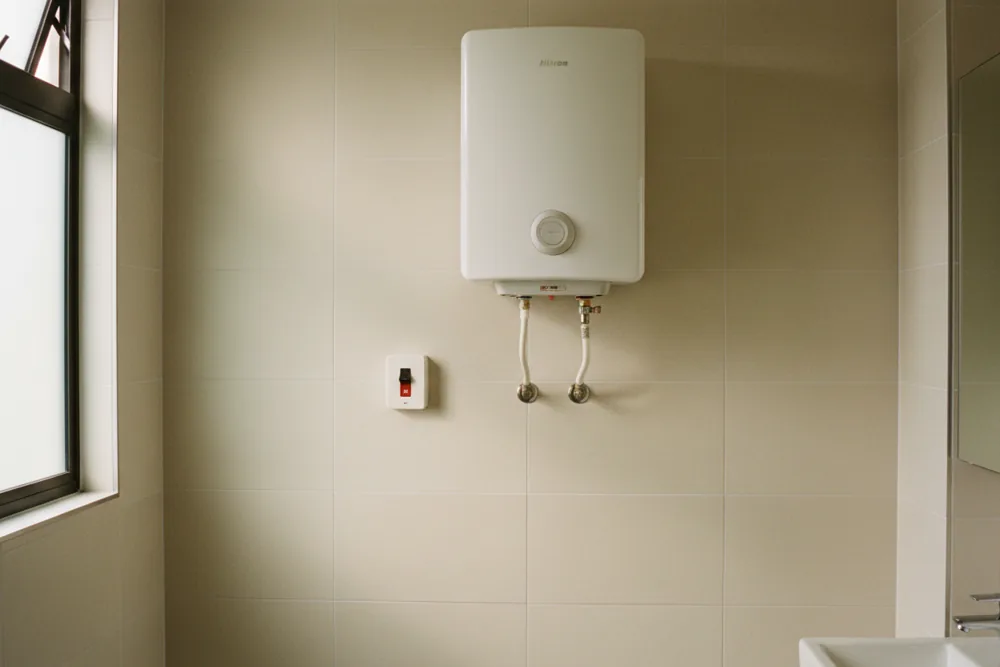
The double-pole isolator within reach of the heater, so it can be fully isolated for servicing.
Earthing and bonding, which matter more in this room than anywhere else in the property.
The connection to fixed wiring itself, which is electrical installation work restricted to a what a Licensed Electrical Worker is licensed to do under EMA’s rules on engaging licensed electrical workers.
And gas is a third regime again: one firm on this search states its gas work is supervised by an EMA Licensed Gas Service Worker, which is a different licence from the electrical one.
The switch on your bathroom wall is not a light switch
There is usually a switch: often with a neon indicator, sometimes a pull cord, near the heater or just outside the bathroom. A surprising number of Singapore households have never known what it does.
It is the water heater isolator, and it should be a double pole isolator. Single-pole switching breaks one conductor and leaves the appliance connected by the other; double-pole breaks both, which is what "isolated" actually means and what anyone servicing or replacing the unit needs. Earlier notes on this page described a single-pole isolator, which was wrong, and it has been corrected rather than quietly deleted.
Two things it is genuinely useful for. Switch it off when you are away for any length of time, a storage tank reheating an empty flat for three weeks is pure standby loss. And switch it off to test whether the heater is what is tripping your power, which is the section below and is the most useful thing on this page.
Storage or instant is an electrical decision before it is a comfort one
Every guide on this search compares the two on hot-water performance and price. The part that decides whether you can actually have one is skipped.
A storage water heater warms a tank gradually and holds it. An instant water heater: tankless, sometimes a multipoint heater serving more than one outlet, makes hot water on demand. Instant water heater installation Singapore therefore starts with the circuit rather than the appliance, because it draws substantially more current while it is running. Same hot shower, very different electrical profile.
So a like-for-like swap in position is not necessarily a like-for-like swap electrically. The existing circuit and its protection were chosen for the appliance that was there. In an older flat the supply itself may also be a constraint: roughly 1,500 pre-1994 HDB blocks are still queued to be raised from a 30A to a 40A supply under the Electrical Loading Upgrading Programme, targeted for completion by 2030, the detail is in HDB electrical loading and the 30A to 40A upgrade.
The order that saves money: find out what the circuit and the supply can carry, then choose the heater. The other order is how people end up with a new appliance and an unquoted new circuit.
Why water heaters trip the RCCB more than anything else in your home
If you came here because your power trips when heater is on, this is the answer, and it is not on any page ranking for this search.
A storage heater’s element sits immersed in water for years. Its insulation degrades slowly, and once it does, a small current starts finding a path to earth instead of returning through the neutral. Your residual current circuit breaker detects exactly that and disconnects: correctly, because the path to earth can be a person. RCCB protection has been mandatory since 1985 for new premises and rewiring, and was extended to all HDB flats and private residences from 1 July 2023, so essentially every occupied Singapore home has one watching this.
The signature is timing. Earth leakage from a degrading element is often intermittent at first and correlates with shower times, not with anything you plug in. It gets steadily less intermittent. What it does not do is fix itself, and repeatedly resetting an RCCB is switching off your protection rather than solving anything, more on the devices in the RCCB, ELCB and MCB explainer and on the wider diagnosis in why the power tripped.
The no-cost test that identifies it
Before you pay anybody, do this.
Switch the water heater off at its double-pole isolator and leave it off for a full day, using the flat normally otherwise. Cold showers for twenty-four hours, and you learn something worth several hundred dollars.
If the tripping stops, it is the heater. That is now an appliance decision, repair or replace, rather than a hunt through your wiring. If the tripping continues, the heater is exonerated and the fault is elsewhere in the installation, which is a genuinely different investigation.
Either way you have converted a vague complaint into a fact. Include the result in your enquiry: a caller who already knows whether the heater is implicated usually turns a diagnostic visit into a single repair visit, and that is the difference between two call-out charges and one.
S$148
Electric water heater installation total, wall or ceiling mounted: published by Mr Plumber 2026
from S$98
Water heater installation, heater and labour: published by Everyworks 2025
S$120–220
New point on trunking, if a circuit has to be run, published by fixmove.sg 2026
Published Singapore prices, and what they leave out
Published third-party figures
S$148: electric water heater installation Singapore total, mounted securely on a wall or ceiling (Mr Plumber, 2026 cost guide). Water heater replacement into an unchanged position sits at the same figure. S$400–700+, gas water heaters.
From S$98: installation covering heater and labour (Everyworks, August 2025).
S$90: install instant water heater, rain shower head, sold as a retail line item (COURTS Singapore).
S$40–80: call-out or minimum charge, plus about S$10 per visit fuel surcharge and roughly S$30 for an urgent slot.
What sits outside those numbers
They assume a suitable supply already exists. That is a fair assumption for a like-for-like replacement into an unchanged position, and a poor one for anything else.
A new dedicated circuit is separate work: published ranges put a new point on trunking at S$120–220.
A distribution board with no spare ways makes it a board job, S$320–800 for DB box repair or replacement, or from S$380 for a 6-way board. See DB box repair and replacement.
These are published third-party ranges collected 18 August 2026, not a quote. Full list on the price ranges page, and the small-visit economics in how call-out minimums work.
Buying installation from the shop
One of the results on this search is a retailer selling water heater installation as a line item you add to your basket. That is a perfectly reasonable way to buy it, with one question attached.
Ask, in writing, what the installation price covers electrically. Fitting an appliance to an existing, adequate supply is not the same job as running a circuit, fitting an isolator, or finding a way in a full board: and the difference is normally discovered on the day, by which point the old heater is off the wall and your negotiating position has evaporated.
The question to send them is short: does the price include a dedicated circuit and isolator if my existing arrangement is not suitable, and what happens if it is not? A good answer is a scope. A vague answer is a variation order waiting to happen.
Either we've got a burned-up outlet, or we've got some wires that maybe came out of the back of the outlet.
Send a photo of the heater, the isolator and your board for a scoped price
Get an electrical quoteReplacing an old heater is the moment to look behind it
A heater comes off the wall roughly once a decade. It is the only time anyone sees the connection, the isolator’s wiring and the cable behind the tank without paying specifically to look.
So use it. Terminations get checked for heat damage and tightness. The isolator gets checked: is it double-pole, does it work, is it somewhere a person can still reach after the new tiling. Earthing gets confirmed rather than assumed. And the circuit is measured against the new appliance, which matters if you are moving from storage to instant.
In a flat old enough that the wiring itself is the question rather than the heater, this is often where that conversation starts, rewiring older homes and the water heater electrical guide cover it in more detail.
HDB water heater installation
Single-phase, usually a storage tank in the bathroom ceiling or high on the wall, with the isolator just outside. Electrical works forming part of a renovation need an HDB permit, and only a licensed electrician may work on the fixed wiring, see HDB renovation guidelines for electrical works.
Older blocks are where the loading question bites hardest. The HDB flat electrician page covers the wider rules, and HDB tripping and common property covers the tripping case.
Ceiling voids and access panels
Condo bathrooms very often hide the heater above a false ceiling. That is fine when there is an access panel and the isolator is reachable, and expensive forever when there is not.
Management approval, working hours and lift protection apply as they do to any other trade, and they affect scheduling more than price.
More heaters, longer runs
Landed properties frequently run several heaters, sometimes on different floors and occasionally on a three-phase supply, which makes circuit planning a genuine design task rather than a swap.
It is also where multipoint instant heaters are most common, and where the load question is most likely to change the answer.
Serviceability: the thing renovations design out
The most avoidable expense on this page is not a price. It is a position.
A heater in a ceiling void with no access panel means the ceiling comes down before anyone touches it. An isolator tiled over, or moved behind a cabinet during a bathroom renovation, means every future visit starts by isolating the whole circuit at the board. An access panel too small to remove the unit through is a classic, and it is only discovered ten years later.
None of that costs anything to get right at the time. If a bathroom renovation is in progress, insist on a reachable double-pole isolator and an access panel sized for removal, and put it in the drawing rather than in a conversation.
What a sound electrical visit involves
Survey: what the heater is or will be, what circuit currently serves it, where the isolator is and whether it is double-pole, and what the distribution board has available.
Work: circuit run or re-terminated, protection fitted or confirmed at the board, double-pole isolator positioned where it can still be reached in five years, connection made and enclosed, earthing and bonding confirmed.
Testing before the electrician leaves: earth continuity to the appliance, insulation resistance on the circuit, confirmation that the residual current circuit breaker operates, and the isolator proven to break both conductors. Ask for the circuit to be labelled at the board, which makes the next fault a short visit instead of a long one.
Where the fault turns out to be the appliance rather than the installation, a good electrician will say so: that is a replacement conversation with a plumber or the manufacturer, not more electrical work. General electrical fault finding covers the general sequence.
Verify the licence, and what to send
Ask for the name and licence number of the Licensed Electrical Worker attending, and check it free on EMA’s public register, following our step-by-step ELISE guide, or go straight to the ELISE licence register. If the job is gas rather than electric, the relevant licence is a Gas Service Worker’s, which is a different register and a different question to ask.
To help scope a price before any visit, send: a photo of the heater and its position, a photo of the isolator, a photo of your distribution board with the labels readable, the model of heater going in, and, if you are here about tripping, the result of the day-long isolation test.
What this page does not claim
This page does not publish circuit ratings or cable sizes for water heaters. They depend on the appliance and the installation, and a number on a web page is not a substitute for the survey. Anyone quoting you a rating before knowing your heater is guessing.
This page does not cover the plumbing. Mounting, pipework and valves are a plumber’s work.
Every figure here is a published third-party range with its source named, collected 18 August 2026. Two earlier figures on this page, a S$50 heater connection and a S$160 isolator, have been withdrawn because they could not be re-verified, and the isolator they described was specified single-pole, which was wrong.
Water heater electrical FAQs
How much does water heater installation cost in Singapore?
Published Singapore figures for electric water heater installation Singapore, collected 18 August 2026. Mr Plumber’s 2026 cost guide puts the total at S$148 where the unit is mounted securely on a wall or ceiling, and gas water heaters at S$400–700+. Everyworks publishes installation from S$98 onwards. COURTS sells installation as a line item, with instant water heater installation for a rain shower head at S$90. Those are plumbing and retail installation prices and they assume the electrical supply is already there and adequate. If a dedicated circuit has to be run, an isolator fitted, or a way found in the distribution board, that is separate work, published ranges put a new point on trunking at S$120–220 and DB box work at S$320–800. None of those figures is a quote.
Do I need a plumber or an electrician for a water heater?
Usually both, and the SERP for this search hides that: every result on page one is a plumbing brand or a heater retailer. The water side: mounting the unit, the inlet and outlet, the pressure relief, is plumbing. The electrical side is not. A water heater is a fixed appliance connected to the property’s fixed wiring, which means a dedicated circuit protected at the distribution board, a double-pole isolator within reach of the appliance, and proper earthing. That connection is electrical installation work restricted to a Licensed Electrical Worker under EMA rules. Gas heaters are a third regime again, supervised by an EMA Licensed Gas Service Worker. Plenty of firms cover all of it properly by engaging the right people; the question is simply who, and can you name them.
What is the switch on my bathroom wall for?
That is almost certainly the water heater isolator, and it should be double-pole. Its job is to disconnect the appliance completely: both conductors, not just one: so the heater can be serviced or replaced safely, and so you can isolate it yourself without going to the distribution board. It is not a light switch and it is not a thermostat. Two practical uses: switch it off when you go away for a long period, and switch it off if you suspect the heater is causing your power to trip. If you cannot find such a switch anywhere near your heater, that is worth asking about, because it means every service call starts at the board.
Why does my power trip when the water heater is on?
Because a heating element is almost certainly leaking current to earth, and your RCCB is doing exactly what it exists to do. Storage water heaters are the single most common cause of repeated earth-leakage tripping in Singapore homes: the element sits in water, it degrades with age, and when its insulation deteriorates a small current finds a path to earth. The tripping is often intermittent at first and correlates with shower times rather than with anything else you switch on. Resetting repeatedly is the wrong response: an RCCB is protecting a person, not an appliance.
How do I prove it is the heater before paying anyone?
Switch the heater off at its double-pole isolator and leave it off for a day, using the property normally otherwise. If the tripping stops, you have your answer without a single billable hour. If it continues, the heater is not your problem and the fault is elsewhere in the installation. This test costs nothing, takes no tools, and appears on no page ranking for this search. Include the result in your enquiry, as it can turn a diagnostic visit into a repair or replacement visit and may save you a call-out.
Can an instant heater go where my storage heater was?
Not automatically, and this is the question the retail pages skip. A storage heater warms a tank slowly over time; an instant heater produces hot water on demand, which means it draws substantially more current while it is running. The existing circuit, its protection and in some cases the flat’s supply were sized for the appliance that was there before. In an older flat that matters: roughly 1,500 pre-1994 HDB blocks are still queued for upgrading from a 30A to a 40A supply under the Electrical Loading Upgrading Programme. So the sequence is: check what the circuit and the supply can carry, then choose the heater. Doing it the other way round is how a new heater ends up needing a new circuit nobody quoted for.
Does the shop’s installation service include the electrical work?
Ask, in writing, before you add it to the basket. Retailer installation is normally priced for fitting the appliance where a suitable supply already exists, which is fine when you are replacing like for like into an unchanged position. It is not the same as running a new dedicated circuit, fitting an isolator, or finding a way in a full distribution board. If the answer is that additional electrical work is chargeable on the day, that is the moment to have it scoped, not while someone is standing in your bathroom with the old heater already off the wall.
What is the average lifespan of a water heater?
Google asks this twice on this search, which suggests the single-number answers are not satisfying anyone. More useful is what actually ends them. Storage heaters usually fail through the tank and the element: internal corrosion, a sacrificial anode long since consumed, sediment, and eventually either a leak or an element that starts leaking current to earth. Instant heaters fail more often through their controls and their element. The signals worth acting on are water that is lukewarm when it used to be hot, rust or staining in the water, visible weeping around the unit, and any new tendency to trip the RCCB. A heater that has started tripping is telling you something about its remaining life, not just about this week.
Which is the best water heater brand in Singapore?
This site does not sell heaters, so rather than a ranking, here is what the choice changes for the electrical side. Whether the unit is storage or instant matters far more than the badge, because it decides the load. Physical size and mounting position decide whether the existing isolator and circuit are still in a sensible place. Some models add controls, timers or smart features that need a supply of their own consideration. And serviceability matters: a heater installed in a ceiling void with no access panel and an isolator behind tiling will cost you every time it needs attention, whatever the brand on the front.
Related guides
Blog
Water heater electrical guide
Circuits, isolators and what ages first, in more depth.
Read more Blog
Blog
RCCB, ELCB and MCB explained
Which device is protecting a person, and why it trips.
Read more Service
Why the power tripped
The wider diagnosis when it is not the heater.
Read more
Service
Circuit breakers and DB boxes
When the heater needs its own way in the board.
Read moreTell us about the heater and its circuit
Send a photo of the heater and its position, a photo of the isolator, a photo of your distribution board with the labels readable, and the model going in. If your power has been tripping, run the day-long isolation test first and include the result, as it can save a whole visit.
Loading… if the form does not appear, contact us there instead.
If you see smoke or fire, call SCDF at 995 before anything else.
Island-wide
HDB, condo, landed and business premises
Electrical half
The circuit, the isolator and the diagnosis: the water side is a plumber’s
Check the licence
Ask the electrician for their name and licence number, then check it on ELISE
Tripping at shower time? Isolate the heater for a day, then tell us what happened
Arrange a tripping checkCitations
Sources for every figure on this page
Every figure quoted above is a published third-party number, not an estimate of ours. Where sources disagree, both are shown. Collected and last reconciled 21 August 2026.
-
That electrical installation work is restricted to a Licensed Electrical Worker, and what to ask before letting anyone start.
EMA: engaging licensed electrical workers , checked 21 August 2026
-
That residual current circuit breakers are required in all homes from 1 July 2023.
HDB Pulse: residual current circuit breakers required in all homes , 2023
-
Which electrical works in an HDB flat need approval, and the conditions attached.
HDB: renovation guidelines for electrical works , checked 21 August 2026
-
That the licence register is public, free and searchable before any work begins.
ELISE: EMA’s public licence register , checked 21 August 2026
-
Published 2026 Singapore price ranges for common electrical jobs.
Published prices move. If a figure here no longer matches the source, the source wins, tell us and it gets corrected rather than quietly left to rot.
Last updated