Water heaters · Guide · Updated 18 August 2026
Instant Water Heater Installation Singapore or Storage Instead?
Storage vs instant water heater Singapore comparisons all cover comfort and efficiency. This one covers the circuit, which is usually what actually decides it.
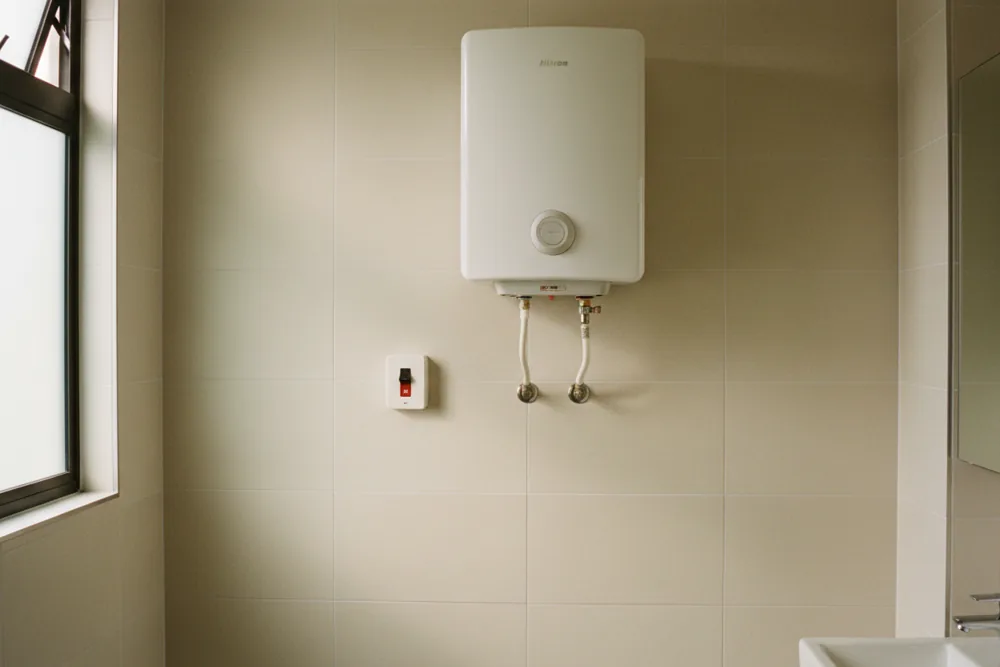
The short version
The paradox, and the answer: NEA recommends instantaneous heaters over storage types on efficiency grounds, and Singapore homes keep installing storage tanks anyway. A large part of the reason is electrical. An instant water heater draws far more current while running; a storage water heater spreads a smaller load over time. So your circuit and your block’s supply often decide this before your preference does, which is why the check comes before the purchase.
The comparison everyone else has already made
Fairly and briefly, because it is well covered elsewhere. A storage water heater heats a tank in advance and holds it ready, one ranking page puts the warm-up at around thirty minutes, so it serves more than one outlet and runs out if you overuse it, then needs recovery time. An instant water heater has no tank, heats on demand, gives unlimited hot water and generally serves one tap at a time, with output depending on flow rate.
Storage incurs standby heat loss keeping the tank warm. Instant does not. That is the efficiency argument in one sentence, and it is the argument the next section complicates.
What NEA recommends, and what Singapore installs
The Straits Times reported in November 2025 that NEA recommends instantaneous heaters over storage types, and prefers gas heaters over electric storage heaters on standby-heat-loss grounds.
And yet: on this same results page, a Singapore home group thread asks why storage water heaters are so popular although they are inefficient, and a Reddit thread with eighty posts argues the same question from the other direction. Something is not adding up in the published comparisons.
The electrical reason the recommendation is not always actionable
Efficiency is about energy over time. Your circuit cares about current at a moment. An instant heater has to raise the temperature of water as it flows, which means a large draw for the minutes it runs. A storage heater does the same total work spread across a much longer period at a much lower rate.
The same arithmetic decides whether a flat can take a wallbox charger on its own circuit: two large loads running together is what the supply has to be sized for.
So the appliance that is better on the efficiency measure is the one that is harder on the installation, and in a flat whose circuits and supply were sized for a storage tank, that constraint is real. It is not a rebuttal of the recommendation; it is the reason it is not always straightforward to act on.
Load: the difference that decides it
A like-for-like swap in position is not necessarily a like-for-like swap electrically. The existing circuit, its protection and in some cases the supply into the unit were chosen for the appliance that was already there.
Which means the sequence that avoids an unwelcome surprise is: establish what the circuit and supply can carry, then choose the heater. The other order is how people end up with a new appliance and an unquoted new circuit, see installing a dedicated water heater circuit.
Check your loading before you choose
In an older flat the supply itself can be the constraint. Roughly 1,500 pre-1994 HDB blocks are still queued to be raised from a 30A to a 40A supply under HDB’s Electrical Load Upgrading Programme, targeted for completion by 2030. Checking your block takes about a minute, see which blocks are in the load upgrade programme.