Aircon · Guide · Updated 18 August 2026
Aircon Isolator Switch: What It Does and What It Costs
The aircon isolator switch Singapore question that actually gets asked: why the aircon isolator switch Singapore price is several times the price of the switch itself.
The short version
The short version: the switch costs roughly S$20–54 on the shopping results of this very search. Having one fitted starts around S$120 before transport, and a from-the-board arrangement is published at S$180–350. That gap is not markup on a part, it is access, weatherproof termination, the right circuit, testing and a call-out. And if the point is new and 15A, your flat’s loading status decides whether a permit is involved.
Does an aircon need an isolator?
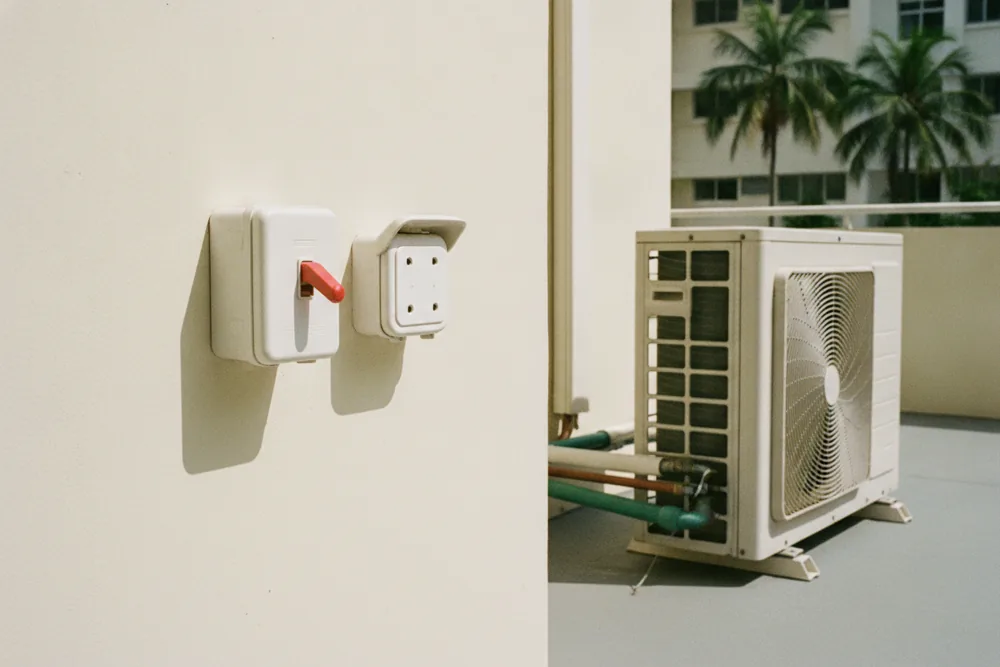
In practice, yes, and the reason is obvious the first time anyone services the unit. An isolator lets the outdoor condenser unit be disconnected at the unit, rather than sending somebody to a distribution board on the other side of the flat to switch off a circuit that may not be labelled.
It lives outdoors, so it needs a weatherproof enclosure, which is why the retail listings on this search emphasise IP ratings. And it should be double pole.
What "double pole" actually means
Both conductors switched, live and neutral, rather than just the live. That is what makes isolation genuine rather than approximate, a Reddit comment on this very search puts it plainly: with a double-pole switch off, live and neutral are both disconnected.
A single-pole switch leaves the appliance connected by one conductor, which is fine for turning something off and inadequate for working on it.
Why the installed price is several times the part
This search is unusually honest about the gap, because both numbers are on the same page. The shopping results list isolators at roughly S$20.50 to S$54. An electrician ranking here publishes double-pole isolator replacement from S$120 before transport. A supplier lists an aircon isolator arrangement at S$180–350, depending on whether it is run from the distribution board.
People see the S$25 listing and conclude the quote is markup. It is not, and the next section is what actually sits in the difference.
What you are actually paying for
Access. Outdoor units sit on ledges, in service voids and on external walls. Reaching one safely is often the longest part of the visit.
Weatherproof termination that will survive years of sun and monsoon, the difference between a connection that lasts a decade and one that fills with water. The right circuit, in many cases a dedicated circuit, correctly identified and correctly connected. Testing afterwards. And the call-out or minimum charge, which published Singapore sources put that call out fee at roughly S$40–80 plus about S$10 per visit fuel surcharge, see call-out fees and minimum charges.
The part is the least significant item on that list, which is why the part price tells you almost nothing about the job price.