Power trips · Guide · Updated 18 August 2026
Electrical Trip Meaning and What to Do First at Home
Power trip what to do Singapore, answered in order. My HDB has a power trip what should I do, power trip how to reset, and the part other guides skip.
The short version
My HDB has a power trip. What should I do? If anything smells of burning or feels warm, do not reset, call. Otherwise: switch off and unplug everything on the affected circuit, note which device tripped, reset it once, then restore appliances one at a time. Before any of it, look outside: if the corridor is dark, it is not your problem. And if the reset will not hold, skip to what to do when it will not reset, because that is the part other guides leave out.
Before you reset anything
There is a short list of things that mean do not reset at all. Every guide on this search opens with the reset steps. This one opens with the exception, because resetting into a fault is how a small problem becomes an expensive one.
Smoke or flame is SCDF on 995, first and before anything else. Short of that, these all mean stop: a burning smell, a breaker or faceplate that is warm to the touch, browning or blistering around a terminal, an arcing crack or a buzzing sound, or visible scorching. Heat means energy is being dissipated somewhere it should not be, and every reset puts it back.
In that situation, isolate the affected circuit if you can identify it safely from outside the board, stop using it, and get a licensed electrician, that is what out-of-hours emergency response exists for.
Step 1: switch off and unplug the affected circuit
Do this before you touch the board. It stops a failed appliance from re-presenting the fault the instant you reset, and it is the step almost everyone skips.
Switch off and unplug what you can on the dead circuit, particularly the heavy loads: kettle, air fryer, iron, water heater, air-conditioner. If you cannot tell which circuit is which, that is worth fixing later, a labelled board turns your next fault into a twenty-minute job.
Step 2: find which device operated
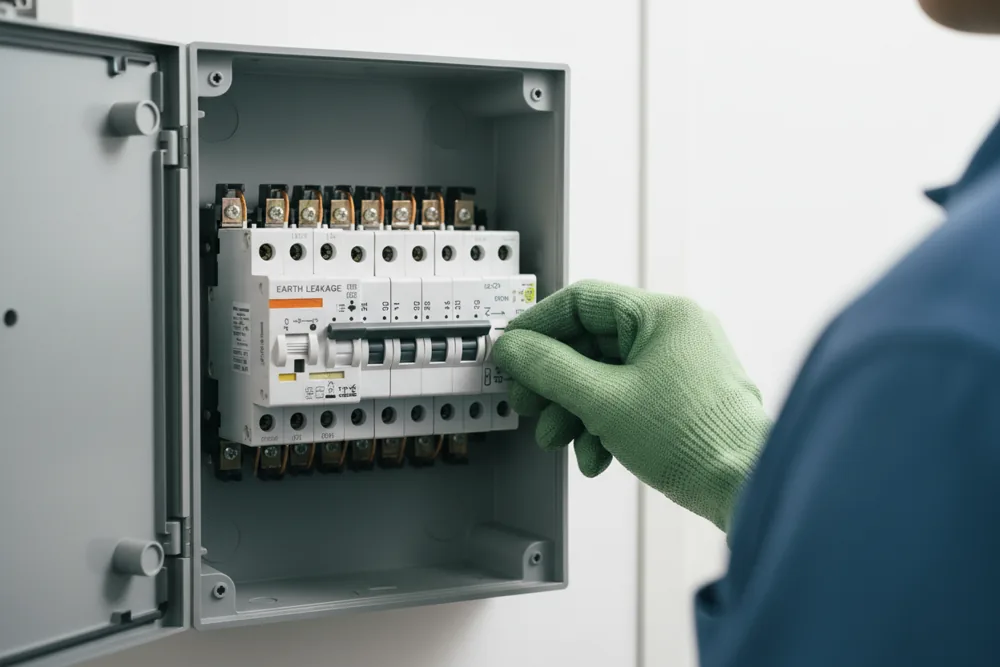
A tripped device sits in a different position from its neighbours: usually midway, sometimes fully down. Open the distribution board cover, look along the row, and note which one moved before you touch anything.
Then photograph it. It costs nothing, and a photograph of the board tells whoever attends more than any description you will manage over the phone at eleven at night.
MCB or RCCB? It changes what happens next
This is the fork that most guides skip, and it is the most useful thing you can observe. An MCB, one of the row of smaller switches, trips on overcurrent: too much load, or a short circuit on that one circuit. An RCCB, usually larger and set apart, trips on earth leakage: current returning by some path other than the neutral, and that path can be a person.
So an MCB trip sends you looking at what was running. An RCCB trip sends you looking at moisture, a failing heating element, or damaged insulation. Different symptom, different suspect list, the guide to each protective device covers the devices properly.
Step 3: power trip how to reset, once
Once. Not twice, and never repeatedly on an RCCB. Push the device fully to off first, then to on, a partial reset often will not latch, which is why people conclude a breaker is broken when it is not.
If it holds, good: you have a working flat and a suspect list. If it does not, stop and read the next-but-one section rather than trying again.
Step 4: restore in halves (the half split)
Plug things back one at a time, waiting a minute between each. This appliance elimination is the whole method: Earth leakage in particular often takes a moment to present, so a fast run-through can miss the culprit entirely.
A residual current circuit breaker in particular needs that pause. Whatever trips it is your answer, and you have just done the diagnostic work an electrician would otherwise charge you for. Write down what it was and whether the trip was instant or delayed.
What if it will not reset?
This is where every other guide on this search stops, and it is where most readers actually are. The most-discussed thread on this query is a Singapore homeowner saying exactly this: the flat blacked out, they tried resetting the circuit breaker, and it did not work.
First, stop resetting. Then narrow it with one test: unplug everything on that circuit and try once more. The answer splits two ways, and both are useful.
Everything unplugged and it still trips
The fault is in the fixed wiring or the device itself, not in anything you own that has a plug on it. That is a licensed electrician’s job: there is nothing further to gain from another attempt, and you have usefully eliminated every appliance in the flat.
It holds, then trips again minutes later
Usually load or heat. Either the circuit is carrying more than it was designed for, or a connection is deteriorating and warming as current flows through it. In an older block it can also be the supply rating rather than a fault at all, see the 30A supply limit in older HDB blocks.
It trips only when it rains
Look up, not at the board. Water reaching a ceiling light point or the wiring serving it produces enough earth leakage to operate an RCCB with nothing wrong in your installation at all. Seepage from the unit above, a roof, or around a window is enough. The tell is that tripping tracks the weather rather than what you switch on, and the real repair is the leak.
My electric box has tripped, but is it mine at all?
Sixty seconds at the front door can save you an entire call-out fee. Look along the corridor and out of the window.
Corridor dark, neighbours affected, stack out? That is supply-side, and SP Group’s investigation and repair are not charged to you. Corridor or staircase lighting only? Common property, so the town council, at no cost to you. Only your flat? Then it is your installation. That is the hdb power trip who to call question, and the full routing sits in who to call when an HDB flat trips and whether the outage is SP’s or yours.
Can it wait until morning?
Often yes, and the difference is real money. Singapore forum reporting documents a homeowner paying S$120 for a midnight inspection and being quoted S$900 at around 1am, against S$50 to inspect and up to S$550 the next morning, spreads of roughly 1.6x to 2.7x.
A same day electrician slot in ordinary hours costs materially less than a night visit. If one circuit is off, nothing is warm and nothing smells, isolating that circuit and booking the first daytime slot is a legitimate choice. What removes it: heat, a burning smell, visible damage, or no lighting at all.
What a call out fee costs
Published Singapore ranges, collected 18 August 2026: an ordinary-hours call-out or minimum charge is roughly S$40–80, plus about S$10 per visit as a fuel surcharge and around S$30 more for an urgent slot. If the board itself needs work, published guides put DB box repair or replacement at S$320–800.
None of those is our rate, and a power trip electrician Singapore homeowners engage should say so too. Worth knowing: a large share of power trip visits end with no part replaced at all, because the cause turns out to be an appliance. More detail in how call-out fees are structured and on our Singapore electrical price guide page.