HDB power trip · Singapore
HDB Power Trip Who to Call: SP Group or a Private Electrician
The short answer, before anything else. Smoke, flame or burning smell: SCDF on 995. Neighbours dark too, or the whole stack out: SP Group, published fault line 1800-778-8888. Corridor or staircase lighting: your town council, at no cost to you. Only your flat, and nothing warm or smelling: a licensed electrician, and it can often wait for a daytime slot. The rest of this page is how to tell which, and why there is no HDB electrician hotline to call.
- Ask for the cause before parts
- Check the licence on ELISE
- SP Group 1800 778 8888 for supply faults
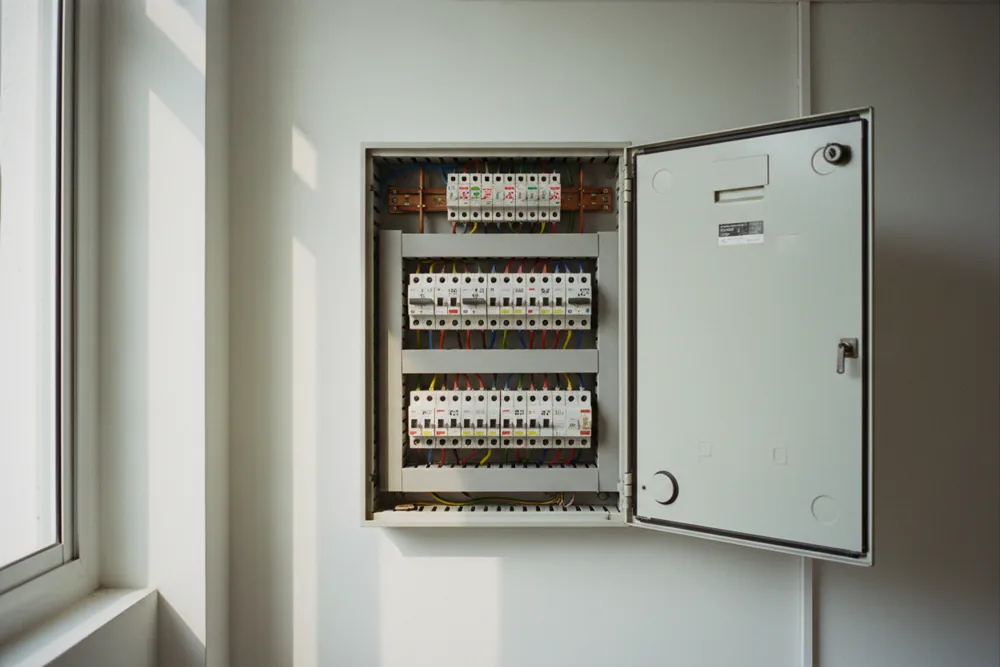
Before you reset anything in an HDB flat
Smoke or flame is 995, first
Short of that, these all mean do not reset: a burning smell, a breaker or faceplate warm to the touch, browning or blistering around a terminal, an arcing crack or a buzzing sound.
Isolate that circuit if you can identify it safely from outside the board, stop using it, and call. Heat means energy is being dissipated where it should not be, and every reset puts it back, this is exactly what requesting an emergency electrician is for.
Nothing warm, nothing smelling, reset once
Once. Not repeatedly, and never repeatedly on an RCCB, because that device is protecting a person from earth leakage rather than protecting an appliance.
If it holds, work through the appliance elimination below. If it trips again immediately with nothing plugged in, leave it off, you have learned something useful and there is nothing to gain by trying again.
Then it is not your installation at all
Corridor dark, the stack out, several flats affected: the fault is on the supply side of the meter and SP Group’s investigation and repair are not charged to you.
Paying a private electrician to attend a supply-side outage buys you the advice to call SP, see how to tell a supply outage from a flat fault.
HDB power trip who to call: there is no HDB electrician hotline
Two of the questions Google attaches to this search ask for the HDB electrician hotline number, and one asks how to call the HDB hotline. So it is worth stating without hedging: HDB does not send an electrician into your flat to fix a fault inside it.
The reason is a boundary rather than a policy. Everything after the meter is your installation: the distribution board, the circuits, the accessories, the appliances. Work on it is restricted to a Licensed Electrical Worker under EMA’s rules on engaging licensed electrical workers, and it is the flat owner’s responsibility, not the landlord of the estate’s.
What genuinely exists is three different numbers for three different problems, and the whole skill is telling them apart in the sixty seconds before you dial. That is the next section.
Why so many people believe otherwise
Worth being fair about, because the belief is everywhere and it is not stupid. The most visible comment on a Facebook thread with fifty-plus comments, ranking on this very search, says you should call HDB if the problem is with the DB or circuit breaker, because HDB is responsible for the electrical loading of flats.
Half of that is true. HDB really does run the Electrical Loading Upgrading Programme, raising roughly 1,500 pre-1994 blocks from a 30A to a 40A supply. HDB really did install RCCBs in older flats from December 2022 when the requirement was extended to all homes. If you have watched contractors work on your block’s electrical infrastructure, concluding that the board in your hallway is also theirs is an entirely reasonable inference.
But an infrastructure upgrade programme is not a repair service. The board inside your flat is yours, and a tripping circuit inside your flat is a Licensed Electrical Worker’s job. The Reddit answer ranking above that Facebook thread gets this right: if the breaker is the one inside your flat, you call a licensed electrician.
When the fault is before the meter
SP Group owns the network up to and including your meter. If the stack, the floor or the block has lost power, that is theirs, and where the fault is on their side the investigation and repair are not charged to you. Their fault line is published as 1800-778-8888.
Worth checking before you dial: are the corridor lights on, do neighbours have power, is anything visible from the window in the block opposite.
When it is common property
Corridor and staircase lighting, lift lobbies, risers and communal electrical services are the town council’s responsibility, at no cost to you. The boundary is broadly your front door.
This is one of the most common ways HDB residents pay for something they need not have, more in where town council responsibility ends.
When it is inside your flat
Only your unit affected and the fault after the meter: that is your installation, and beyond resetting a device it is licensed work. A power trip electrician Singapore residents can verify is one whose licence number you can check before they arrive.
For the full diagnostic logic, what each tripping pattern means, see why the power tripped, in detail.
HDB power trip how to fix: power trip how to reset, and how to find the cause yourself
Assuming the safety check above is clear. One ranking page on this search says you do not have to call an electrician in most cases, and that is honest, a large share of HDB trips end with a faulty kettle in the bin.
Switch off and unplug everything on the affected circuit first. This stops a failed appliance re-presenting the fault the instant you reset, and it is the step almost everyone skips. Identify which device operated, a tripped switch sits in a different position from its neighbours, because an MCB and an RCCB mean different things. Reset once, pushing fully to off before switching on.
Then restore in halves. Plug things back one at a time with a minute between each, because earth leakage often takes a moment to present. Whatever trips it is your answer, and water heaters, kettles, ageing air-conditioners and fridges lead the Singapore list, see water heater wiring for the most common single culprit.
What this is not: opening the distribution board, changing a device, or touching wiring. Stay outside the board, that line is where restricted work begins. Step by step: a safe first-five-minutes checklist.
A circuit breaker tripped outside my HDB unit
A real question from a Singapore homeowners’ group, and one that no commercial page on this search answers.
In many blocks the meter and a main switch sit in a common riser compartment in the corridor rather than inside the flat. That is why a resident can find a tripped device out there while the board in the hallway looks untouched.
Two things follow. It usually means the fault is upstream of your consumer unit, which is a larger question than one circuit tripping inside the flat. And, more important, that compartment can serve more than one household, so it is not somewhere to start switching things. Note what you can see, note whether neighbours are affected, photograph it if you can do so safely, and let SP Group or a licensed electrician act depending on which side of the meter the fault turns out to be.
HDB power trip during lightning
This is a search Singaporeans genuinely make, and nothing on this results page addresses it. Three different things hide behind it.
A single trip during a storm is usually protection working. A surge on the supply, or the switching that follows one, can operate a device correctly. If it resets and holds and nothing else is odd, that is the system doing its job rather than a fault.
Repeated storm-correlated tripping is a different matter, and in Singapore the leading explanation is not electrical at all. It is water: heavy rain reaching a ceiling light point or the wiring serving it produces enough earth leakage to operate an RCCB with nothing whatsoever wrong in your installation. Seepage from the unit above, through a roof, or around a window is enough.
The tell is timing. If the tripping tracks the weather rather than what you switch on, treat moisture ingress as the leading suspect. An electrician can isolate the affected point so the rest of the flat works, but the real repair is the leak, and if it originates upstairs or in common property, it may not be your bill at all.
Tell us which device tripped and what was running at the time
Request a diagnosisIf I have something going off in my house, I'm just gonna assume it's a bad breaker... well, there's some things you kind of have to figure out.
What the pattern is telling you
What it does
Trips the instant you reset, nothing plugged in.
Trips only when one appliance runs.
Trips under heavy load, in an older block.
Trips when it rains, or after cleaning.
The RCCB does not trip when you press its test button.
What that usually means
A live fault on that circuit. It will not clear itself, and repeated resetting achieves nothing.
That appliance. The most common cause, and the one that costs you nothing but an evening to establish.
Possibly load rather than fault, see the supply-rating section below rather than assuming something is broken.
Moisture ingress. Look up at the ceiling, not at the board.
The protection is not there when you need it. That is the one genuine reason to replace a device, and it needs a Licensed Electrical Worker.
How many times can a breaker trip before it needs replacing?
Google asks this on this search, and the answer is more useful than the question. Almost never is the breaker the problem.
EMA published a forum reply titled “No Need to Replace Circuit Breaker If It Works”. A device that keeps tripping is overwhelmingly likely to be operating correctly against a fault nobody has found. Counting trips measures the alarm rather than the fire.
Two genuine exceptions, both needing testing rather than guessing: a breaker that will not hold with its circuit completely disconnected, and an RCCB that no longer trips when tested. The test button on the device exists precisely to prove the second, press the RCCB test button and the device should trip. If it does not, that is a fault in the protection itself and it needs a licensed electrician. Replacing a breaker without a diagnosis remains the most common wasted repair in Singapore homes, more at DB box and breaker replacement.
Load, not fault: the older-flat case
Not every trip is something breaking. In an older block it can be the supply rating meeting modern appliances.
Roughly 1,500 pre-1994 HDB blocks are queued to be raised from a 30A to a 40A supply under HDB’s Electrical Loading Upgrading Programme, targeted for completion by 2030. A flat still on the older rating, now running an air-conditioner, an induction hob, a water heater and a kettle at once, can trip on load with nothing at all defective.
The signature is different from a fault: it happens at predictable moments of heavy simultaneous use, it resets and holds, and nothing is warm afterwards. The fix is not a new breaker: it is loading, circuit arrangement, or usage. Detail in upgrading a flat from 30A to 40A, and the wider rules in HDB electrical services.
Tonight or tomorrow? The honest economics
Worth stating plainly, because it can save you real money.
In a HardwareZone thread on a midnight breaker quote, a homeowner paid S$120 for an inspection at midnight and was quoted S$900 at around 1am. The next-morning comparison: S$50 to inspect, up to S$550 to replace. Reported spreads run roughly 1.6x to 2.7x.
After-hours pricing is not automatically unfair, unsocial hours and a single-visit callout are real costs. But the choice should be yours to make deliberately. If one circuit is off, nothing is warm and nothing smells, isolate that circuit, keep the rest of the flat live, and ask for a daytime visit.
What removes the choice: heat, a burning smell, visible damage, or no lighting at all. What to do when an HDB power trip leaves you weighing a night call: the call out fee is the lever. Published minimums and surcharges are in our guide to night call-out charges and on our price benchmarks page.
S$40–80
Ordinary-hours call-out or minimum charge, published Singapore sources
+S$30
Typical premium for an urgent or customer-requested slot, fixmove.sg 2026
1.6x–2.7x
Reported spread between a midnight quote and a next-morning quote
If you rent the flat
A large share of Singapore’s HDB stock is tenanted and not one page on this search mentions it, so here is the general shape.
The fixed installation is the landlord’s. The distribution board, the wiring, the accessories, the light fittings that came with the flat, those are their property and their responsibility to keep in working order. An appliance you brought with you is yours, and if the half-split points at your own kettle, that is your problem to solve.
Practically: tell the landlord immediately and in writing, even at an awkward hour. Arranging a licensed electrician on your own initiative and presenting the invoice afterwards is how tenancy disputes start. The exception is safety: if there is smoke, burning or heat, make it safe and call 995 first, then sort out who pays.
What the visit involves, and what you should get
The board first: what the flat is fed with, what protection is in place, and which device actually operated. Then testing rather than swapping, insulation resistance and earth leakage on the affected circuit, and appliance elimination if you have not already done it.
The aim is a named cause, not a replaced part. Ask for the quote before the repair. If a part has to be ordered, a good electrician leaves the affected circuit isolated and everything else working.
And you should end up with something in writing: what was found, what test result supports it, what was done, and the name and licence number of the Licensed Electrical Worker. If a flat trips again a week later and nobody can produce a diagnosis from the first visit, that absence is itself the explanation.
Verify the licence at the door
Ask for the name and licence number of the Licensed Electrical Worker attending. A genuine licence card carries a photo, name, IC number and licence number.
Check it free on EMA’s public register: it takes about a minute, and it works just as well at 2am: confirm their EMA licence online, or go straight to the ELISE licence register.
One thing worth knowing when you are tired and it is late: several businesses advertising emergency electrical work are branded as handyman services. That branding does not change the law, electrical installation work requires a licensed worker, whoever is holding the screwdriver. Plenty engage one properly; the question is simply who, and what is their number.
What this page does not claim
No maintenance schedule is published here without a source. Your RCCB has a test button and pressing it should trip the device; a device that does not trip on test needs a Licensed Electrical Worker. This page will not invent a frequency and attribute it to HDB.
Every figure here is a published third-party range with its source named, collected 18 August 2026, and none of them is a quote. Phone numbers are as published by the organisations concerned and are worth confirming.
You may not need a private electrician at all if the answer is SP Group, the town council, or a faulty kettle. All three happen more often than an actual installation fault.
HDB power trip FAQs
What is the HDB electrician hotline number?
There is not one, and Google asks this twice on this search, so it is worth saying plainly. HDB does not send an electrician into your flat to fix a fault inside it. Everything after the meter is your installation, and work on it is restricted to a Licensed Electrical Worker. What does exist: SP Group for anything on the supply side, with a fault line published as 1800-778-8888; your town council for corridor, staircase, riser and other common-property electrical faults; and a licensed electrician for faults inside your flat. If the situation involves smoke, flame or burning, it is SCDF on 995 before any of those.
Should I call HDB if the problem is the DB box or the circuit breaker?
No, although it is a very widely held belief: the most visible comment on a fifty-comment Facebook thread ranking for this exact search says you should, on the grounds that HDB is responsible for the electrical loading of flats. The confusion is understandable: HDB does run the Electrical Loading Upgrading Programme raising older blocks from 30A to 40A, and HDB did install RCCBs in older flats from December 2022. But a programme to upgrade block infrastructure is not a repair service for the distribution board in your hallway. That board and everything downstream of it belongs to the flat, and fixing it is a Licensed Electrical Worker’s job.
How do I know whether it is SP Group’s problem or mine?
Look outside before you dial anything. If the corridor is dark, the stack is out, or several flats have lost power, the fault is on the supply side and SP Group’s investigation and repair are not charged to you, their fault line is published as 1800-778-8888. If your neighbours have power and only your unit is dark, the fault is after the meter and it is inside your installation. If it is the corridor or staircase lighting itself, that is common property and belongs to the town council, at no cost to you. Sixty seconds of looking saves an entire call-out fee often enough to be worth making a habit.
How do I reset a power trip safely?
First, clear the safety check: a burning smell, a warm breaker or faceplate, browning, buzzing or any smoke means do not reset at all. If nothing is warm and nothing smells, switch off and unplug everything on the affected circuit, identify which device operated: a tripped switch sits differently from its neighbours: then reset it once, pushing fully to off before switching on. If it holds, restore appliances one at a time with a minute between each. If it trips again immediately with nothing connected, leave it off and book an electrician. One ranking page on this search says you often do not need to call anybody, and that is honest: many HDB trips end with a faulty kettle in the bin.
A circuit breaker tripped outside my HDB unit. What does that mean?
In many blocks the meter and a main switch sit in a common riser compartment in the corridor rather than inside the flat, which is why residents sometimes find a tripped device out there. Two things follow. First, it usually means the fault is upstream of your consumer unit, which is a bigger question than a single circuit tripping inside the flat. Second, and more importantly: that compartment can serve more than one household and it is not somewhere to start switching things. Note what you can see, note whether neighbours are affected, and let SP Group or a licensed electrician deal with it depending on which side of the meter the problem sits.
Why does my HDB power trip during lightning?
This is a live search in Singapore and nobody on this results page answers it. Three things are usually going on. A storm-time trip is often protection operating correctly against a surge, and a single trip that resets and holds is not a fault. Repeated storm-correlated tripping suggests either a genuine surge-protection question or, far more commonly here, water: heavy rain reaching a ceiling light point or its wiring produces enough earth leakage to operate an RCCB with nothing whatsoever wrong in your installation. The tell is that tripping tracks the weather rather than what you switch on, and the real repair in that case is the leak, not the electrics.
How many times can a breaker trip before it needs to be replaced?
Almost never is the breaker the problem, and there is a government source that says so: EMA published a forum reply titled "No Need to Replace Circuit Breaker If It Works". A device that keeps tripping is usually operating correctly against a fault that has not been fixed. Counting trips measures the alarm rather than the fire. Two genuine exceptions exist and both need testing rather than guessing: a breaker that will not hold with its circuit completely disconnected, and an RCCB that no longer trips when its test button is pressed. That second one is the more serious, because it means the protection is not there when it is needed.
Can it wait until morning?
Often, and the difference is real money. Singapore forum reporting documents a homeowner paying S$120 for a midnight inspection and being quoted S$900 at around 1am, against S$50 to inspect and up to S$550 the next morning, spreads of roughly 1.6x to 2.7x. Out-of-hours pricing is not automatically unfair; unsocial hours cost real money. But if one circuit is off, nothing is warm and nothing smells, isolating that circuit and asking for a daytime visit is a legitimate decision. What removes the choice: heat, a burning smell, visible damage, or no lighting at all.
I rent the flat. Do I call the landlord or an electrician?
Nothing on this search addresses renting, which is odd given how much of Singapore’s HDB stock is tenanted. In general: a fault in the fixed installation: the board, the wiring, the accessories: is the landlord’s to resolve, because it is their property. A faulty appliance you brought with you is yours. Practically, tell the landlord immediately and in writing, because arranging a licensed electrician without their knowledge can leave you arguing about the invoice afterwards. The exception is anything unsafe: if there is smoke, burning or heat, make it safe and call 995 first, and sort out the paperwork later.
Related guides
Blog
RCCB, ELCB and MCB explained
Which device in the flat board tripped, and why that matters.
Read more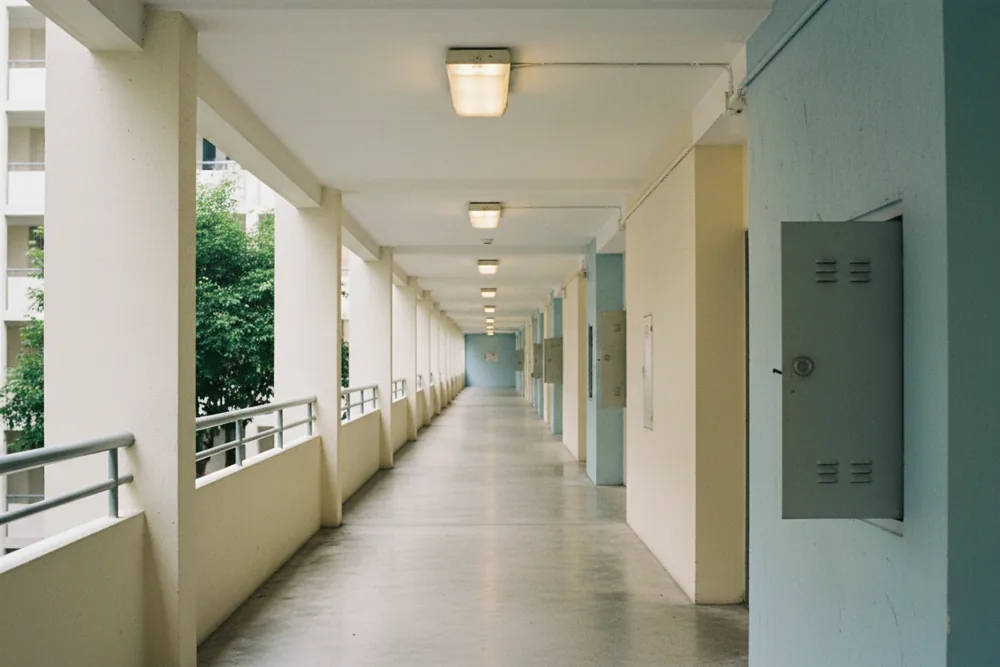 Blog
Blog
Town council or private electrician
Where the boundary sits, and what you should never pay for.
Read more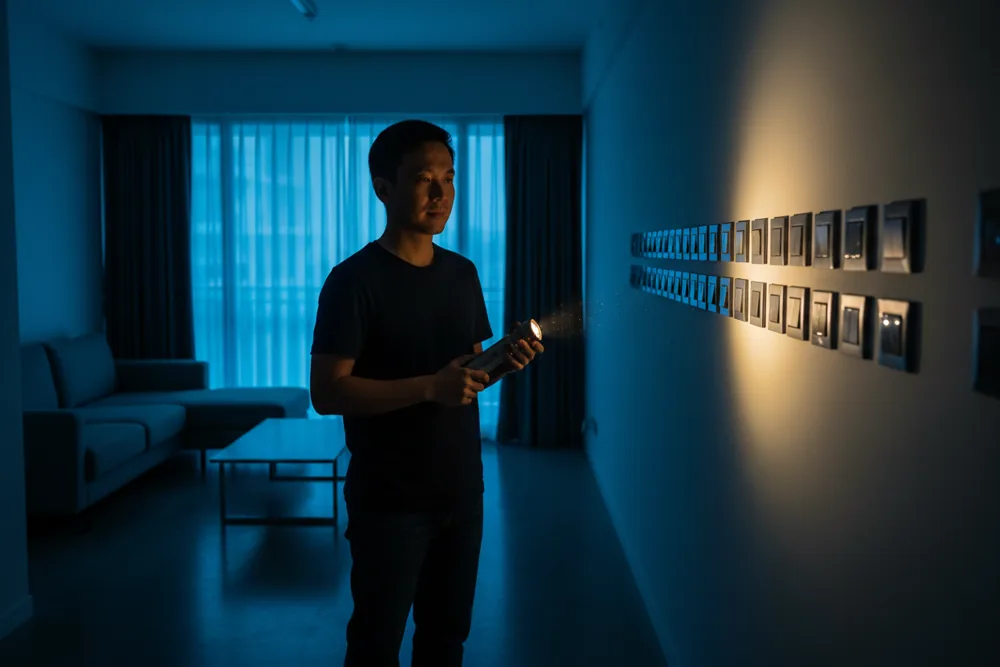 Blog
Blog
Is the outage SP’s or yours?
How to tell in sixty seconds, from your own window.
Read more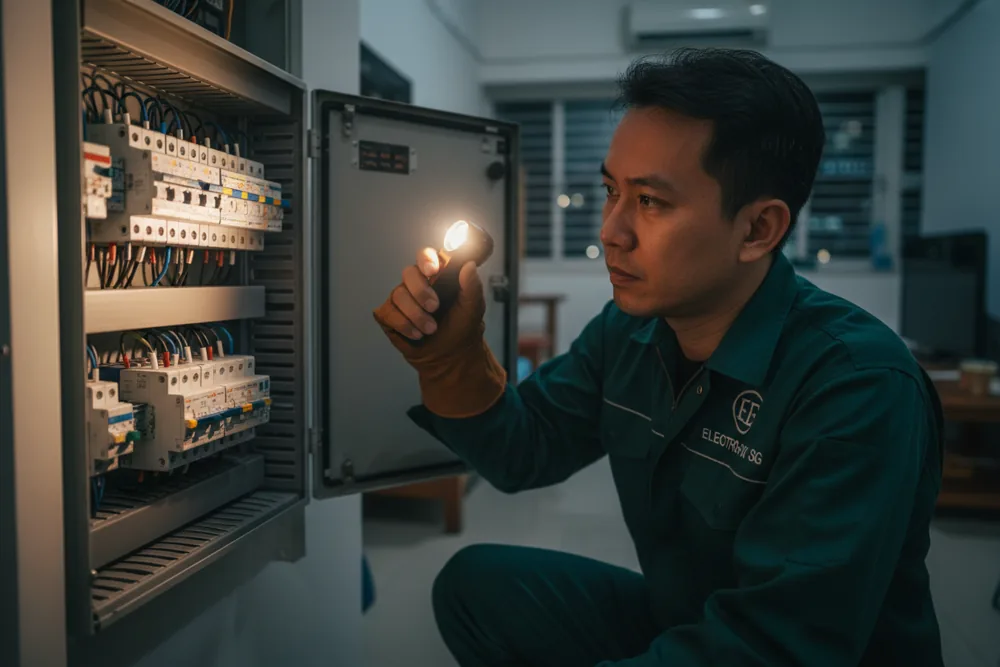 Service
Why the power tripped
The full diagnostic logic behind each tripping pattern.
Read moreTell us what happened
One message is enough: which device tripped, what was running at the time, what you have already tried, whether your neighbours have power, and your block and flat type, and how urgent it is. If you have run the appliance elimination, tell us what you found, it usually turns a diagnostic visit into a repair visit.
Loading… if the form does not appear, contact us there instead.
If you see smoke or fire, call SCDF at 995 before anything else.
Island-wide
HDB flats in every town
Cause first
Ask for the fault to be named before any device is replaced
Check ELISE
The electrician who attends must hold a current EMA licence
Holding until morning? Send the details now and say it can wait for a daytime visit
Request a daytime visitCitations
Sources for every figure on this page
Every figure quoted above is a published third-party number, not an estimate of ours. Where sources disagree, both are shown. Collected and last reconciled 21 August 2026.
-
That electrical installation work is restricted to a Licensed Electrical Worker, and what to ask before letting anyone start.
EMA: engaging licensed electrical workers , checked 21 August 2026
-
That a working circuit breaker does not need replacing, cited against the routine upsell.
EMA forum reply: “No need to replace circuit breaker if it works” , 2023
-
Community reporting of after-hours quotes: cited as reported experience, not as a rate card.
HardwareZone forum thread: overcharged for a midnight breaker replacement , January 2023
-
That the licence register is public, free and searchable before any work begins.
ELISE: EMA’s public licence register , checked 21 August 2026
-
That residual current circuit breakers are required in all homes from 1 July 2023.
HDB Pulse: residual current circuit breakers required in all homes , 2023
-
Branch-by-branch isolation method for a tripping breaker. Cited for method only: US practice, not Singapore regulation.
United Tradesman Academy (US): breaker tripping troubleshooting, cited for method only , published 15 February 2022
Published prices move. If a figure here no longer matches the source, the source wins, tell us and it gets corrected rather than quietly left to rot.
Last updated