EV charging · Singapore
EV Charger Installation Singapore
Installing a home charger in Singapore is not one appointment with an electrician. It is a regulated sequence: LTA approves the model, a licensed worker installs and certifies it, a Certificate of Fitness is issued, and you register it. This page walks the whole chain, tells you who is responsible for each step, and publishes what it costs.
- Ask for the LEW name, check ELISE
- Confirm the model is LTA type approved
- Ask for a supply assessment before a unit
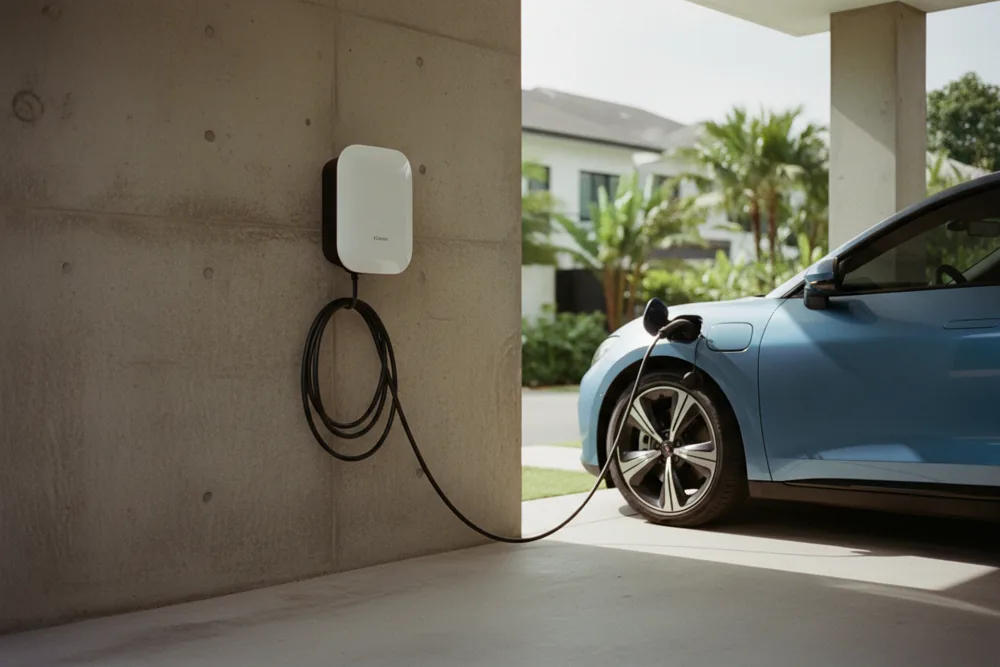
The four stages, in order
Almost every guide on this topic is really a guide to choosing a charger model. That is the easy part. The part that catches people out is the order of operations, because getting it wrong means owning a unit you cannot legally register.
Stage one: type approval, before anything is bought. New EV chargers must be type approved by LTA before they can be installed, certified and registered. Approval is granted model by model. The single most expensive mistake in this whole process is buying a unit, often a grey import, occasionally a bargain from overseas, that was never type approved here.
Stage two, installation and certification. The physical work is electrical installation work, which means it is restricted to an EMA Licensed Electrical Worker. The installation is then certified. This is where the LEW endorsement that installer websites advertise actually matters.
Stage three, the Certificate of Fitness. Issued after installation and certification, and required at registration. Keep it. It is the document that proves the chain was followed, and you will want it if you ever sell the property.
Stage four: registration, then the mark. The charger is registered with LTA, and once registration succeeds it may be used immediately. A registration mark must then be affixed within 60 days.
Who is responsible for which step
Yours, as the owner
LTA places registration on the charger owner, along with maintaining the certifications over time.
That includes the periodic inspection cycle described below, and it continues for as long as you own the charger.
This surprises people. The common assumption is that the installer owns the paperwork permanently because they did the work. They do not, you do.
Theirs, supplier and installer
The supplier is responsible for ensuring the approval label is affixed before the charger is supplied to you.
The installer and the LEW are responsible for the installation itself and its certification.
Plenty of installers will file the registration for you as a courtesy or as part of the package. That is genuinely useful: just get it in writing rather than assuming it, because the obligation still sits on your side of the line.
The 12-month inspection nobody mentions
Here is a cost of ownership that appears on no page-one result for this search, and in very few installation quotes. At non-restricted access locations, an EV charger must be inspected every 12 months by a Licensed Electrical Worker licensed by EMA.
The distinction that matters is restricted versus non-restricted access. A charger inside a locked private garage that only you can reach is a different case from one in a condominium carpark, a shared driveway, or anywhere the public or other residents can walk up to it. If your charger sits somewhere others can physically reach, assume the inspection obligation applies and plan for it.
This is worth raising during quoting rather than a year later. EV charger inspection cost is not something anyone advertises, so ask whether the installer offers the annual EV charger inspection, what they charge for it, and whether they will remind you, or whether you are tracking the date yourself.
Where to find the LTA approved EV charger list
Type approval is held by LTA and granted per model, so the authoritative answer to “is this charger allowed here” lives with the regulator rather than with a retailer. Check the model before you pay for it.
The risk case is a unit bought overseas or from a marketplace seller on price alone. It may be a perfectly good charger in the country it was built for and still be unregistrable here, at which point you own hardware you cannot legally commission. An installer who asks what model you have already bought, rather than telling you what they can install, is one to be careful with.
TR25, LEW, LTA, what the credentials on installer websites actually mean
Three different bodies, three different things, routinely run together in marketing copy as though they were one badge.
LTA governs the charger as a piece of equipment: type approval, certification, registration, the registration mark, the inspection cycle. EMA governs the person doing the electrical work through the Licensed Electrical Worker scheme, what EMA licensing requires applies here exactly as it does to any other fixed electrical installation. TR25 is the technical reference the industry works to for EV charging installations; it is cited by most established installers, and it is a standard rather than a licence.
So “LEW endorsed, TR25 compliant” means the work was done by a licensed person to the industry standard. It says nothing about whether your specific charger model is type approved, and nothing about who is filing your registration. Those are separate questions and worth asking separately.
How to vet an EV charger installer in Singapore
Type “EV charger installer Singapore” into Google and what comes back is mostly equipment sellers and manufacturers. An EV charger supplier and an EV charger company that sells hardware are not the same thing as the licensed worker who will actually wire it, and the phrasing people search with: EV charger installation, installation EV charger, EV charger install, home EV charger Singapore, hides that distinction rather than resolving it. That is the question the search results themselves show is unanswered. On the day this page was researched, a Facebook group thread titled “Recommended EV charger installers in Singapore?” was ranking on page one of Google, above four commercial installers. When a community thread outranks the businesses, it means the businesses are not answering the question.
Five things worth asking before you commit:
Which named LEW will do the work? The licence attaches to a person, not a company. Ask for the name and verify any electrician’s licence yourself on the public register.
Is the charger model already type approved? Ask before you pay a deposit on hardware.
Who files the registration, and who holds the Certificate of Fitness? Both answers should be in the quote, not implied.
Do you do the 12-month inspection? If they look blank at this question, that tells you something.
Will you assess the supply before recommending a unit? Anyone who recommends a 22kW charger before looking at your distribution board is selling hardware, not solving your problem.
Ask any installer to show you the licence and the approval
Get a quoteWhat it costs
Not one of the four installer and equipment pages we crawled on page one of Google publishes a price. Anyone researching EV charger cost or EV charger price Singapore is therefore working from forum guesses and undated blog posts, which is how people end up comparing a hardware-only figure against an all-in one and concluding they are being overcharged.
So here are the published Singapore ranges, sourced and dated. These are market figures rather than our rates, and none of them is a quote for your installation.
That's going to be eight to 10 hours pulling 32 amps.
S$1,500–3,000
Charger unit, typical range (ElectGo Singapore homeowner guide, 2025)
S$800–2,000
Installation, typical range (same source): before supply upgrades or load management
S$2,000–8,000
All-in total commonly cited, with around S$3,500 quoted as an average
What actually drives your installation quote
Two identical chargers in two identical condos can differ by well over a thousand dollars to install, and it is almost never the charger causing it. Five things move the number.
Cable run distance from the distribution board to the parking space. This is usually the single biggest variable, and it is why a site assessment beats a phone quote every time.
Whether your existing supply can carry the load. A charger is a large, sustained, dedicated load. If the incoming supply or the board cannot take it, the upgrade is a separate job, see the HDB loading limits for how tight the margins can be, and DB box replacement for what a board upgrade involves.
Surface trunking versus concealed routing. Concealed looks better and costs more. In older properties it can also mean discovering things nobody wanted to discover, which is occasionally where rewiring enters the conversation.
Single-phase or three-phase. This determines what you can install at all, not just what it costs.
The dedicated circuit and its protection. An EV charger gets its own circuit and its own protective device. That is not an upsell, it is how the job is done correctly.
7kW or 22kW? The answer is usually your supply, not your car
7kW single-phase, most homes
A 7kW EV charger: an AC wallbox on a single-phase supply, fitted with the Type 2 EV charger socket that is standard here, and the same class of unit North American sites call a Level 2 EV charger: is the standard Singapore home installation, and for most people it is not a compromise.
The reason is dwell time. A car parked from 8pm to 7am has eleven hours of charging available. A 7kW unit refills a typical daily commute several times over in that window, so a faster charger simply finishes earlier in the night while you are asleep.
It is also the option most existing domestic supplies can take without an upgrade, which keeps the installation cost in the published range rather than above it.
22kW three-phase, the exception
A 22kW charger needs a three-phase supply. Most Singapore homes do not have one, and retrofitting it is a substantially larger piece of work than the charger installation itself.
It earns its place where there is genuine daytime turnaround: two EVs sharing a lot, a home that doubles as a business base, or a landed property already on three-phase for other reasons.
Larger loads also start to interact with the limits that govern which licence grade may carry out the work, which is a conversation worth having before ordering hardware. Our the home EV charger deep dive goes further into unit selection.
Landed homes: the straightforward case
If you own the house and the parking, there is no third-party approval layer. You are dealing with LTA and an LEW, and nobody else has a say. That makes landed the cleanest case by a wide margin, and it is why the one competitor guide that covers installation properly covers landed only.
The first real step is an assessment of the existing supply, not a conversation about brands. After that, the cost driver is routing: how far the cable travels, whether it goes through finished spaces, and how much of it is exposed. Carport and driveway installations also need outdoor-rated equipment and sensible positioning, Singapore weather is unkind to anything specified for indoor use.
Condominiums: the MCST is the real gatekeeper
In a condo the electrical work is usually the simple part. The management corporation is the constraint, because the cable from the building supply to your lot crosses common property, and common property is theirs to control.
There are three separate conversations hiding inside one request. Permission: will the MCST allow an installation at all, and under what conditions. Metering, how the electricity you use is measured and separated from common-area supply. Cost, who pays for the electricity and for any shared infrastructure. Some developments have a considered policy; others have never been asked and will take months to decide.
Whether your lot is allocated to you or shared changes the design entirely. Ask the MCST before buying a charger, not after, and see our HDB and condo EV charger guide for the approval process in more detail. Larger developments putting in multiple bays are effectively doing commercial and workplace installations, with the licence grades that implies.
HDB carparks: what is and is not possible
The honest answer for most HDB residents is that a private home charger is not on the table, and the reason has nothing to do with electricity.
Most HDB parking is not an allocated lot. You hold season parking for the carpark, not a specific bay, so you park wherever there is space. A fixed charger needs a fixed bay to serve, and without one there is nothing to install against. Above that sit the town council and the carpark operator, who control the infrastructure regardless of what any electrician thinks.
For the majority of HDB EV owners the realistic route is the public charging network being deployed across HDB carparks. Where a private installation genuinely is possible, a small number of allocated or reserved lots, it becomes an operator and town council question first and an electrical question second. Our HDB electrical work hub covers the wider HDB rule set.
Are there grants for EV charger installation?
A page-one competitor poses this question in its own FAQ and does not really answer it, so here is a straight one: do not assume a grant applies to your installation.
Vehicle-side incentives for buying an EV are a different thing from support for installing a charger, and the two get conflated constantly in undated blog posts. Schemes also change. We are not going to imply one exists to win a click, check the current LTA position directly before you count on one when working out what this will cost, and treat any figure you find in an article without a date on it as unreliable.
What to have ready before you ask for a quote
Property type, and whether the lot is yours. Landed, condo or HDB, and allocated or shared. This determines the entire shape of the job.
Rough distance from your distribution board to the parking space. Pacing it out is fine. It is the biggest cost variable and most people have never thought about it.
A photo of your distribution board. It shows the supply arrangement, the spare ways available and the age of the installation in one image.
Your car’s onboard charger rating. Some cars cannot accept more than a certain AC rate, which occasionally settles the 7kW question before anyone looks at the supply.
Any MCST or town council correspondence you already have. If approval is already granted or already refused, that changes the conversation immediately.
Although there's a spare way here, we can't use it.
After installation: living with a registered charger
Keep the Certificate of Fitness with your property documents rather than in an email thread. It is the proof that the chain was followed.
Watch the 60-day window for affixing the registration mark after registration.
Diarise the 12-month inspection if your charger is at a non-restricted access location. It is easy to forget an obligation that arrives once a year with no reminder attached.
If you move, the registration moves with paperwork. LTA applies a S$35 fee to a transfer of registration, payable by the transferor, and the same S$35 to a relocation. Worth knowing before you either sell the property with the charger in place or take it with you.
And if the charger ever trips its circuit repeatedly or shows damage, treat it as you would any other fixed electrical fault, that is a job for an emergency electrician rather than something to reset and hope about.
Where our figures come from
Regulatory requirements on this page: type approval, certification, the Certificate of Fitness, registration, the registration mark and the 12-month inspection, were taken from LTA’s own registration of EV chargers page and verified on 17 August 2026. TR25 is attributed to industry practice; LTA’s registration page does not name it, and we are not going to imply otherwise.
Cost ranges come from a 2025 Singapore homeowner guide and other named Singapore industry sources, all dated. None of it is our own rate and none of it is a quote for your installation, your figure depends on the assessment. See our published price guide for how we handle pricing across every service.
EV charger installation FAQs
How much does it cost to install an EV charger in Singapore?
Published Singapore ranges put the charger unit at roughly S$1,500–3,000 and the installation at S$800–2,000, with all-in totals commonly cited between S$2,000 and S$8,000 and around S$3,500 quoted as an average. The spread is real: cable run distance, whether your supply needs upgrading, and single-phase versus three-phase move the number more than the brand of charger does.
Do I need LTA approval to install an EV charger?
The charger model does. LTA states that new EV chargers must be type approved before they can be installed, certified and registered. Type approval is granted model by model and held by LTA, so the practical step is to confirm your intended unit is already approved before you buy it, not before you install it.
Who registers the EV charger with LTA, me or the installer?
LTA places registration and the maintenance of certifications on the charger owner. Many installers will handle the submission on your behalf as part of the job, but the obligation is yours, so get it in writing which of you is doing it. A Certificate of Fitness, issued after installation and certification, is needed at registration.
Does an EV charger need to be inspected every year?
At non-restricted access locations, yes. LTA requires periodic inspection every 12 months by a Licensed Electrical Worker licensed by EMA. This is an ongoing cost of ownership that very few installation quotes mention, so it is worth asking whether your installer offers the inspection or whether you arrange it separately.
Can I install an EV charger in an HDB carpark?
Usually not as a private installation, because most HDB parking is not an allocated lot, you park where there is space rather than owning a bay. Without a designated lot there is nothing to attach a private charger to. The town council and carpark operator sit above any electrical question, and public charging deployment is the realistic route for most HDB residents.
Do I need MCST approval to install an EV charger in a condo?
Yes, in practice. Your cable run crosses common property, so the management corporation controls whether the installation can happen at all. Approval, how the electricity is metered, and who pays for it are three separate conversations. Have them with the MCST before you buy a charger rather than after.
Should I get a 7kW or a 22kW EV charger?
For most Singapore homes, 7kW. A 22kW unit needs a three-phase supply that most homes do not have, and the extra speed is largely wasted on a car parked overnight, a 7kW single-phase AC wallbox refills a typical daily commute several times over in the hours you are asleep. Your supply usually decides this, not your car.
Are there government grants for EV charger installation in Singapore?
Do not assume one applies to your installation. Incentive schemes change, and vehicle-side EV incentives are not the same thing as charger-installation support. We will not imply a grant exists to win a click. Check the current LTA position directly before you factor one into what you expect to pay.
Can I install an EV charger myself?
No. Electrical installation work in Singapore is legally restricted to a Licensed Electrical Worker under the Electricity Act 2001, and an EV charger is a substantial dedicated load on a fixed circuit. On top of that, the installation has to be certified before the charger can be registered, and self-installed work will not get you a Certificate of Fitness.
Tell us about your parking and your supply
Property type, where you park, and roughly how far that is from your distribution board. We pass the job to an electrician who can take it. That person must hold a current EMA licence: ask for their name and check it on ELISE, and ask for a supply assessment before any unit is recommended.
Loading… if the form does not appear, contact us there instead.
If you see smoke or fire, call SCDF at 995 before anything else.
Still deciding?
If you are choosing hardware, the home EV charger deep dive covers unit selection properly. If you live in a flat or a condo and the approval layer is your real obstacle, start with our HDB and condo EV charger guide.
And whoever you end up using, spend the two minutes it takes to verify any electrician’s licence yourself before work starts.
EV charger installation island-wide
Coverage is island-wide. In practice the work concentrates where private parking does: the landed belts around Bukit Timah, Holland, Serangoon Gardens, Katong and the East Coast, and the condominium clusters through the central and eastern districts.
Wherever you are, the sequence is the same: assess the supply, confirm the model is approved, install and certify with a licensed worker, then register. A good electrician will tell you at the assessment that your supply needs work, rather than discover it halfway through an installation.
Citations
Sources for every figure on this page
Every figure quoted above is a published third-party number, not an estimate of ours. Where sources disagree, both are shown. Collected and last reconciled 21 August 2026.
-
EV charger registration requirements in Singapore.
LTA: registration of EV chargers , checked 21 August 2026
-
A published Singapore homeowner guide to home EV charger selection.
-
That electrical installation work is restricted to a Licensed Electrical Worker, and what to ask before letting anyone start.
EMA: engaging licensed electrical workers , checked 21 August 2026
-
That the licence register is public, free and searchable before any work begins.
ELISE: EMA’s public licence register , checked 21 August 2026
-
Supply capacity as the feasibility gate, and cable route as the price driver. Cited for method only: UK practice, not Singapore regulation.
Artisan Electrics (UK): EV charge point installation, cited for method only , published 3 March 2025
Published prices move. If a figure here no longer matches the source, the source wins, tell us and it gets corrected rather than quietly left to rot.
Last updated