Trust & licensing · Singapore
EMA Licensed Electrician Singapore
In Singapore, electrical work is not something anyone with a screwdriver is allowed to do. The law requires an EMA Licensed Electrical Worker: and the useful part is that you can check any electrician’s licence on a free public register in about two minutes. This page shows you how, and what to check for beyond “does a licence exist”.
- Licensing is set by EMA
- Check any licence on ELISE
- Ask which grade covers the load
Licensing is the law, not a marketing badge
Plenty of trades treat “licensed” as a piece of reassuring copy. In electrical work it is a statutory requirement with teeth. The Electricity Act 2001 restricts electrical installation work to a Licensed Electrical Worker, and the Energy Market Authority is the only body that issues those licences. Not HDB, not BCA, not a trade association, not a training provider.
The part that tends to get left out of these explanations is where the consequences land. Competitors write this section from the electrician’s point of view, the worker risks enforcement action. That is true, and it is not your problem. Your problem is the other half: an insurer can decline a claim after a fire or fault traced to non-compliant work, a buyer’s surveyor can flag it during resale, and the cost of rectifying it falls on whoever owns the property, which is you. A verifiable licence is the least expensive protection you will buy on any electrical job.
EMA’s guidance on engaging licensed electrical workers sets out the requirement in the regulator’s own words, and it is worth two minutes of your time before you engage anybody.

The three LEW grades, and which one your job needs
What each grade covers
LEW Grade 7, Electrician Licence. Installation work up to 45kVA at up to 1,000V. This is the licence class most homeowners will ever deal with.
LEW Grade 8, Electrical Technician Licence. Up to 150kVA of design and 500kVA of operation. The step up for larger commercial and light-industrial loads.
LEW Grade 9, Electrical Engineer Licence. No upper limit. For the largest installations.
These figures are consistent across EMA’s own licence documentation and three independent Singapore industry sources.
Matching the grade to your job
HDB flat, condominium unit, small landed home: Grade 7. Essentially all domestic work: rewiring, DB box replacement, power points, water heaters, lighting, EV charger points, sits inside 45kVA.
Small shop, café, clinic, single-unit office: usually Grade 7, but a three-phase supply or heavy kitchen and cooling loads can push past it.
Larger office floor, F&B kitchen at scale, workshop, light industrial: Grade 8 territory, and the point at which asking the question matters.
Getting this wrong is not a technicality. Work carried out beyond the grade’s limit is not compliant, regardless of how well it was done.

How to check any electrician’s licence in two minutes
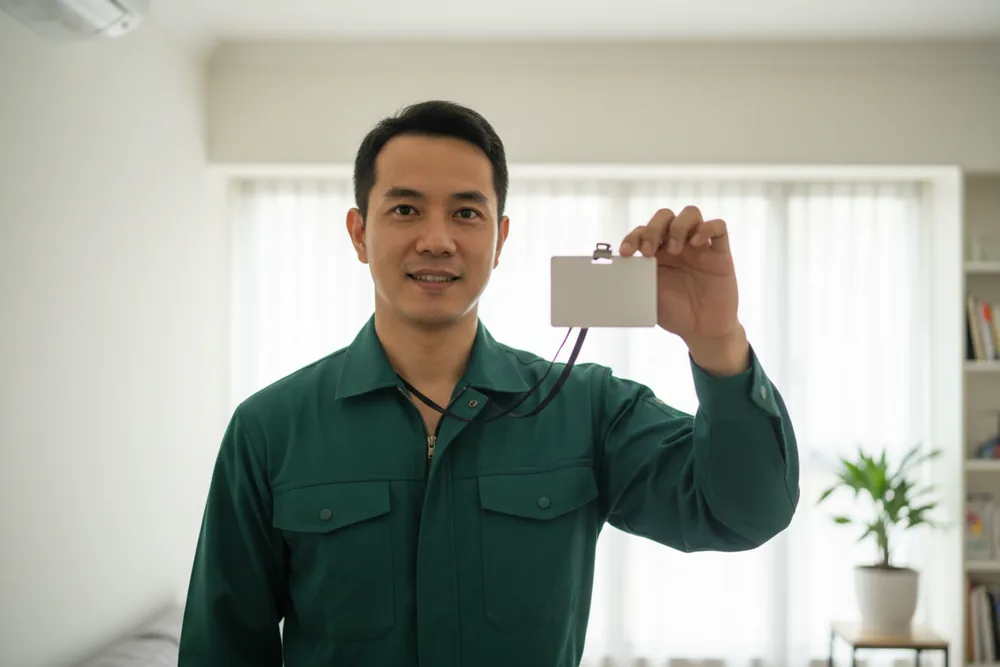
Ask for the licence card. Every LEW carries one. It shows four things worth reading: a photo, the holder’s name, their IC number and the licence number. Match the photo to the person in front of you, that sounds obvious, and it is the step most people skip.
Search ELISE. The Energy Market Authority publishes the ELISE public licence register, free to search by name or by licence number. This is the authoritative record, not a directory someone compiled.
Check three things, not one. Most people stop at “a licence exists”. Also confirm that it is current rather than lapsed, and that the grade covers the size of your installation. A valid Grade 7 licence is the right answer for a flat and the wrong answer for a light-industrial fit-out.
Our step-by-step licence check walks the whole flow with what each screen returns and how to read it.
“HDB-approved electrician” is not a real credential
This phrase is everywhere: in search suggestions, in Google’s own People Also Ask box, and in the article titles that rank for it. Written with a hyphen or without, HDB approved electrician does not describe anything that exists.
HDB does not license, approve or accredit electricians. The Energy Market Authority does, through the Licensed Electrical Worker scheme, and it is the only body that does. What HDB actually publishes is renovation guidelines covering electrical works, plus a register of renovation contractors: a genuinely different scheme, covering different people, for a different purpose.
So when an article offers you “10 HDB-approved electricians”, what it is offering is an editorial roundup. That is not dishonest and such lists can be useful, but they are a magazine’s opinion, not an approvals register, and no reader should treat inclusion as a licensing signal.
There is usually a real question underneath the phrase, though, and it is a good one: is this person familiar with HDB’s rules? That is worth asking directly, because HDB’s renovation requirements sit on top of EMA licensing rather than replacing it. We cover the HDB-approved electrician question in full separately.
You asked for the list. Here is how to generate it yourself
A large share of the people searching this topic are not looking for an explanation at all, they want to be handed the set of licensed electricians, and they search for a list of licensed electrical worker Singapore records as though it were a document someone withholds. That is a completely reasonable thing to want, and the honest answer is better than it sounds.
ELISE is the list. Every Licensed Electrical Worker in Singapore is on it, it is maintained by the regulator, and it is open to the public. No curated article can be more complete, because the register is the source those articles are checked against in the first place.
What the register deliberately does not do is rank or rate anyone. Licensing is binary, you either hold a current licence of the right grade or you do not. Quality, punctuality and pricing are separate questions that no register can answer. The practical approach is to use ELISE to settle legality and reviews, written quotes and referrals to settle everything else.
Certified vs licensed electrician: only one of these words is regulated
Certified, competent, qualified, licensed, these four words get used as though they are interchangeable in advertising copy, and they are not. Certified vs licensed electrician is the distinction that decides whether the work on your flat is legal.
Certified usually means a training certificate exists. It may be a real and rigorous qualification; it carries no authority to carry out installation work. Competent and qualified are descriptive, not regulatory, anyone may use them about themselves. An electrically trained person is a recognised category who may assist under an LEW’s supervision, but is not an LEW. A diploma in electrical engineering is an education, not a licence.
Licensed is the only one of the four that means the Energy Market Authority has authorised this named individual to do the work. When an advert says “certified electricians”, the useful follow-up question is simply: certified by whom, and are they licensed?
The person who quoted and the person who turns up
This is the practical failure mode of licence checking, and almost nobody writes about it. You check a licence carefully, engage the company, and on the day a different person arrives.
Subcontracting is normal in this trade and is not a problem in itself. What matters is that the individual doing the installation work holds the licence: the licence attaches to a person, not to a company or a van. So the check is worth repeating on the day, with whoever is actually holding the screwdriver. It takes a minute and nobody legitimate objects.
The same logic applies to renovation work. A renovation contractor being HDB-registered says nothing about electrical licensing; the electrical portion still has to be done by an LEW. Ask which named person will do it, get that in writing alongside the quote, and check the name on the register before the job starts rather than after.
It's not something that all electricians are comfortable doing, to be honest. A lot of people struggle with it.
Want a licensed electrician you can actually verify?
Request an electricianWhat it costs to use a licensed electrician
A question worth reframing: people often ask whether a licensed electrician costs more, as though there were a legal unlicensed alternative to compare against. There is not. Licensed is the baseline, not a premium tier, so the real question is simply what electrical work costs in Singapore. There is no separate licensed electrician Singapore price list, because there is no unlicensed one.
Published market ranges put the ordinary-hours minimum or call-out charge at roughly S$70–80, with a fuel surcharge of about S$10 per visit common on top. Among frequently quoted jobs, a 13A double socket replacement is published at S$60–120, a light point at S$80–180, a ceiling fan on existing wiring at S$80–220, and a new power point on surface trunking at S$120–220. Distribution board repair or replacement in an HDB flat or condo is published at around S$320–800.
Those are published 2026 Singapore electrician rates and industry guides, named and dated: not a quote for your job. The published price guide carries the fuller breakdown, and typical call-out and minimum fees explains how the attendance component is built.
What licensed work looks like in an HDB flat
Around three quarters of Singapore households live in HDB flats, so this is where the licensing question comes up most, licensed electrician Singapore HDB work is the bulk of the market. The short version: Grade 7 covers essentially all of it. Rewiring, replacing a distribution board, adding power points, water heater circuits, lighting and ceiling fans, an EV charger point in a carpark, all comfortably inside 45kVA.
What changes in an HDB context is that a second rule set applies on top. HDB’s renovation guidelines govern what may be altered, when work may be carried out, and what has to be reinstated, and they apply regardless of who holds which licence. An LEW who works in flats regularly knows both sets of rules; one who does not may be perfectly licensed and still surprise you with a permit issue.
See HDB electrical work for the full treatment, and licensed distribution board work for the job that most often prompts the licensing question in the first place.
Bigger premises: when Grade 7 is not enough
The 45kVA ceiling is generous for a home and tight for a business. Three main things push an installation past it: a three-phase supply, heavy thermal loads such as commercial kitchens or large cooling plant, and simple scale, enough circuits across enough floor area.
If that is your situation, the licence grade stops being a formality and becomes the first question to settle, because it determines who may legally design and certify the installation. Our commercial and larger installations page covers the grade tiers in a commercial context, and office electrical installation covers fit-out work specifically. Larger domestic projects, rewiring a whole house, or EV charger installation with a substantial dedicated load, are worth checking against the same ceiling even when they feel domestic.
What happens if unlicensed electrical work is discovered
Three places it tends to surface, in rising order of expense.
An insurance claim. After a fire or a significant fault, insurers investigate cause. Work that cannot be traced to a licensed worker gives them a reason to question the claim, at exactly the moment you need it paid.
A sale or handover. Buyers, their surveyors and incoming tenants look at distribution boards. Non-compliant work becomes a negotiating point at best and a condition of sale at worst.
Rectification. Putting it right costs more than doing it correctly the first time, because it usually involves opening up finished work. And it lands on the property owner, not on whoever did the original job and has long since moved on.
If you are here to become an LEW
A fair number of people searching this phrase want the qualification route, not a contractor. This page is not that, and pretending otherwise would waste your time. The Energy Market Authority sets the qualification and examination requirements for each grade, and the polytechnics run preparatory courses towards the Electrician Licence. Start with EMA’s worker licence pages rather than with us.
Licensed electrician FAQs
How to check if an electrician is licensed in Singapore?
Ask to see the licence card, which carries a photo, name, IC number and licence number, then search that name or licence number on ELISE, the Energy Market Authority public register, at elise.ema.gov.sg. It is free and takes about two minutes. Check three things: that the licence exists, that it is current, and that the grade covers the size of your job.
Does an electrician need a licence in Singapore?
Yes. Under the Electricity Act 2001, electrical installation work in Singapore must be carried out by a Licensed Electrical Worker licensed by the Energy Market Authority. Singapore spells it licence and the search box usually spells it license, does an electrician need a license in Singapore is the same question, but they are the same thing: an EMA licensed electrician holding a current licence. It is a legal requirement rather than a professional courtesy, and it applies to the work itself, not to the company that quoted for it.
Who are the HDB-approved electricians in Singapore?
There is no such credential. HDB does not license or approve electricians: the Energy Market Authority does, through the Licensed Electrical Worker scheme. HDB publishes renovation guidelines and maintains a register of renovation contractors, which is a different thing. Articles listing "HDB-approved electricians" are editorial roundups, not an official approvals list.
How can I find a Licensed Electrical Worker?
Use ELISE, the Energy Market Authority public register at elise.ema.gov.sg. It is the authoritative list of every Licensed Electrical Worker in Singapore and you can search it by name or licence number. It confirms legality, not quality, pair it with reviews and written quotes to judge the second part.
What is the difference between the LEW grades?
The grades scale with the size of the installation. Grade 7, the Electrician Licence, covers installation work up to 45kVA at voltages not exceeding 1,000V, which covers most homes and small premises. Grade 8, Electrical Technician, covers up to 150kVA of design and 500kVA of operation. Grade 9, Electrical Engineer, has no upper limit.
What is the difference between a certified and a licensed electrician?
Certified usually means someone holds a training certificate or a diploma. Licensed means the Energy Market Authority has authorised them to carry out electrical installation work. Only the licence has legal standing. An electrically trained person may assist under supervision but is not an LEW, and a diploma in electrical engineering is not a licence.
Does my renovation contractor’s licence cover the electrical work?
Not automatically. A renovation contractor being registered with HDB says nothing about electrical licensing. The electrical portion still has to be carried out by a Licensed Electrical Worker, whether that is someone the contractor employs or a subcontractor. Ask which named LEW will do it, and check that person on ELISE.
What happens if unlicensed electrical work is found in my flat?
The exposure lands on you as well as on whoever did the work. Insurers can decline a claim after a fire or fault traced to non-compliant work, buyers and their surveyors flag it during resale, and the cost of rectifying it falls on the owner. The underlying reason for the rule is simpler: bad wiring causes fires.
Does using a licensed electrician cost more?
There is no legal unlicensed alternative to compare against, so licensed is the baseline rather than a premium tier. Published Singapore ranges put the ordinary-hours minimum or call-out charge at roughly S$70–80, with common jobs such as a socket replacement published at S$60–120 and a light point at S$80–180.
Ready to hire a licensed electrician Singapore-wide?
Describe the job and your area, and we pass it to an electrician who takes it. That electrician must hold a current EMA licence of the right grade, so ask for their name and check it on ELISE before anyone starts.
Loading… if the form does not appear, contact us there instead.
If you see smoke or fire, call SCDF at 995 before anything else.
Where to go next
If you have a name and want to check it right now, go to the step-by-step licence check. If you are earlier in the process and weighing options, choosing an electrician in Singapore covers what to ask beyond licensing.
And if the reason you are reading a licensing page at eleven at night is that something has tripped or started smelling of burning, stop here and go to the emergency page instead, you need someone tonight, and you can verify the licence when they arrive.
Requests taken island-wide
Requests are taken island-wide and there is no storefront or branch network. In practice the highest-volume areas are the HDB-dense towns: Bedok, Tampines, Jurong, Ang Mo Kio and Bukit Merah, along with the newer estates in Punggol and Sengkang, and the condominium belt in between.
Whichever area you are in, ask the electrician who takes the job which licence grade they hold, and check it on ELISE when they arrive.
Citations
Sources for every figure on this page
Every figure quoted above is a published third-party number, not an estimate of ours. Where sources disagree, both are shown. Collected and last reconciled 21 August 2026.
-
The licence classes, and which class is required for which scale of installation.
EMA: electrician licence classes and conditions , checked 21 August 2026
-
That electrical installation work is restricted to a Licensed Electrical Worker, and what to ask before letting anyone start.
EMA: engaging licensed electrical workers , checked 21 August 2026
-
That the licence register is public, free and searchable before any work begins.
ELISE: EMA’s public licence register , checked 21 August 2026
-
Which electrical works in an HDB flat need approval, and the conditions attached.
HDB: renovation guidelines for electrical works , checked 21 August 2026
-
Published 2026 Singapore price ranges for common electrical jobs.
-
The Electricity (Electrical Installations) Regulations themselves.
Electricity (Electrical Installations) Regulations, Singapore Statutes Online , checked 21 August 2026
Published prices move. If a figure here no longer matches the source, the source wins, tell us and it gets corrected rather than quietly left to rot.
Last updated