Urgent faults
Emergency Electrician Singapore
An emergency electrician Singapore households call at night is a licensed electrician attending a live fault outside normal hours. One published guide puts a night visit with diagnosis and a simple repair at S$150-400 in total, so work out first whether it truly cannot wait.
- SCDF 995 for fire or smoke
- SP Group 1800 778 8888 for supply faults
- Check the licence on ELISE
Fire, smoke or sparks right now? Call SCDF on 995 before anything else.
Otherwise, start hereCall an emergency electrician Singapore-side only for heat, smell, sparking, exposed wiring, a breaker that will not hold, or a home dark while neighbours have power. Fire or smoke is SCDF on 995; a dark block is SP Group. A published night rate runs S$150-400 for diagnosis and a simple repair.
What does an emergency electrician do?
What an urgent visit usually covers
- Finding which circuit or device is at fault, using tests rather than guesswork.
- Isolating that circuit so the rest of the home can be restored.
- Replacing a burnt fitting or a failed device where the part is to hand.
- Testing before power goes back on, and telling you what the permanent repair involves.
What electrical emergencies require immediate help?
Get help tonight
- A burning or hot-plastic smell from a socket, switch or the board.
- A melted, scorched or blackened faceplate.
- Exposed conductor on any cable.
- A breaker that trips again the instant you reset it.
- Your whole home dark while neighbours still have power.
This can wait for morning
- One dead socket while the rest of the circuit works.
- One flickering light on one fitting.
- A breaker that tripped once, reset cleanly and has held.
- A doorbell or fan that stopped.
These still need a licensed electrician, just not at night. Isolate the circuit and book daytime electrical repair.
What is considered an electrical emergency?
The common thread is heat, smell, arcing or a fault the installation refuses to hold. None of those improve overnight, and two of them get worse. A fault that is simply inconvenient is not an emergency, however annoying it is at 11pm.
Isolate tonight, repair tomorrow
If one circuit tripped, nothing smells or feels warm and the rest of the home works, switching that circuit off and booking a daytime visit is a defensible choice. It saves the after-hours premium and costs nothing in safety.
Smell, heat or scorching: do not wait
Do not reset, and do not wait to see if it happens again. Switch off at the board if it is safe to reach, keep people away from the fitting, and get it seen. If there is smoke, 995 comes first.
Water near sockets or the board
A leak into a ceiling light, a flooded floor near sockets or water on the board is urgent. If you can reach the main switch from a dry spot, switch it off. If you would be standing in water to do it, do not; keep clear and get help.
The five faults behind most night call-outs
Most urgent requests fall into a short list, and each one points to a different first step. Knowing which one you have makes the call shorter and the quote clearer, and it tells you whether the fault is yours to fix at all.
- The RCCB will not stay on. Usually earth leakage from one appliance or circuit, often after rain or cleaning.
- One MCB keeps tripping. An overload or a fault on that circuit, frequently a kitchen or heater circuit.
- The whole home is dark. Check the corridor first; if neighbours are dark too, it is SP Group’s fault.
- A socket or switch is hot or scorched. A loose or overloaded connection, and a real fire risk.
- Lights flicker across the home. Sometimes a supply issue, sometimes a loose neutral; both need checking.
Only the fourth is never a wait-until-morning fault. The others depend on smell, heat and whether the breaker holds.
What is the phone number for emergency electrical services in Singapore?
There is no single number, because the right call depends on where the fault is. Two of the three answers cost you nothing.
- Fire, smoke or visible sparking: SCDF on 995, first.
- Whole block or floor dark: SP Group on 1800 778 8888, a published round-the-clock line.
- Only corridor or lobby lights out: the town council, because it is common property.
- Only your home dark, or one circuit faulty: a licensed electrician.
Check the corridor and a neighbour before you book anyone. EMA’s own outage advice starts the same way.
How much do electricians charge in Singapore?
For urgent work, one published Singapore guide (mrelectrician.sg, published 2026-04-17) puts a night visit with diagnosis and a simple repair at S$150-400 in total, including a call-out or diagnostic fee of S$80-150 with the night surcharge.
Daytime rates for small jobs are lower. FixMove’s 2026 list (read 2026-09-18) puts a socket replacement at S$60-120 and a light point at S$80-180, plus a S$10 fuel surcharge per visit. See the sourced price guide for more.
Why night rates are higher
Unsocial hours, a single job per trip and parts bought at short notice are real costs, so a night premium is not in itself a sign of overcharging. The fair test is whether you were told the price before work started, and whether the scope matches what was done.
How an after-hours bill is built
- Attendance: the call-out or diagnostic charge, higher at night.
- Labour: the time to find and fix the fault.
- Parts: a breaker, a socket, a length of cable.
- Testing: confirming the circuit is safe before power is restored.
One reported night quote, and the morning comparison
A HardwareZone forum user described flickering kitchen lights, clicking and a burning smell after midnight in a five-year-old HDB flat. The after-hours electrician charged S$120 for the inspection and quoted S$900 to replace burnt breaker components.
- Next-morning quotes were about S$50 to inspect and at most S$550 for the replacement.
- On this one report the night figure was roughly 1.6 times the daytime quote.
- Where the circuit can be isolated safely, a daylight quote can be a real option.
What this does not say: Anonymous self-report, unverified, one job; the scope of the midnight and morning quotes may not have been identical. Not evidence of typical pricing.
Three rules before anyone starts work
Urgency makes it tempting to skip checks you would insist on in daylight. These three take a couple of minutes at the door and protect you from the most common problems with night work.
- Ask for the name and licence card, and search the name on ELISE.
- Ask for the price before the repair: attendance, labour and parts, ideally in writing.
- Ask what was found, not only what was replaced, so the cause is on record.
None of this is rude, and nobody legitimate objects. Making a fault safe tonight and pricing the full repair in daylight is a normal way to split a job, and a good electrician will offer it.
What “made safe” should mean
- The faulty circuit is identified and isolated, with the rest of the home restored.
- Nothing is left exposed, and any damaged fitting is disconnected.
- You are told what was found and what the permanent repair involves.
If the only thing that changed overnight is a bigger breaker, the fault has been hidden rather than made safe. Ask for the cause in plain words before you pay.
Anybody can be trained to install, but if you can troubleshoot you're going to be very valuable.
What to have ready before you call
- Which device moved: the main switch, the RCCB or a single MCB.
- Whether it held when reset, or tripped again at once.
- What was running when it happened, and any smell, heat or scorching.
- Your property type and area, and how urgent it feels.
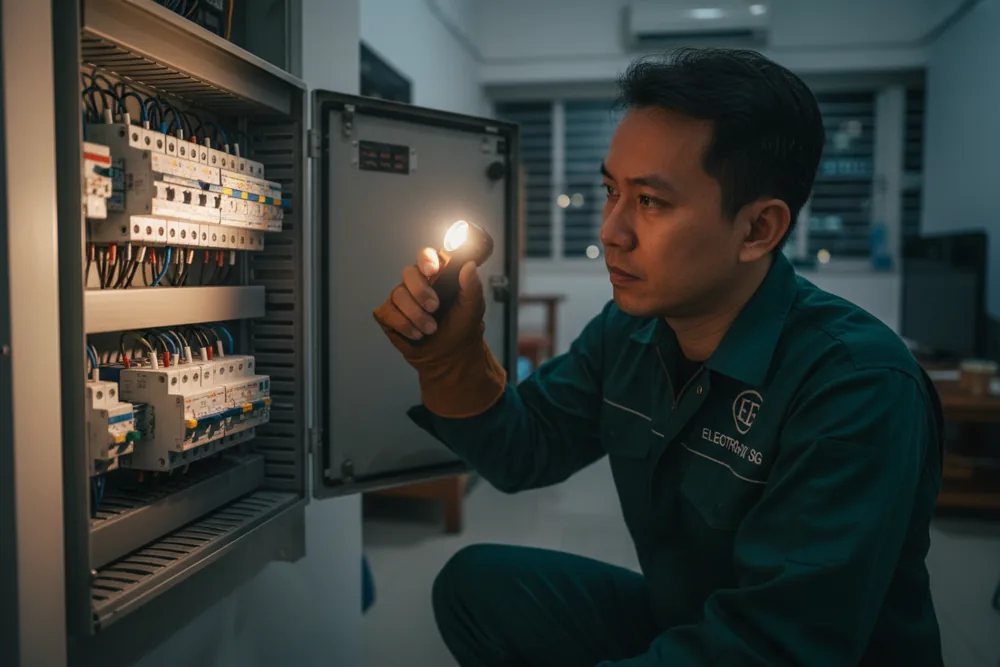
These are free to observe and they shorten the visit. The figure below shows what to look at on the board. A clear photo of the board, taken with the torch on, answers most of the first questions an electrician will ask, and it lets you describe the job accurately when you request one.
Emergency faults in HDB flats, condos and landed homes
In an HDB flat, the boundary is your front door: inside is yours, corridor and riser faults are the town council’s. Our HDB flat electrical rules cover permits and loading.
Most HDB faults at night are a single tripped circuit, which is often a daytime job once it is isolated.
Condominiums and landed homes
In a condominium, common areas belong to the managing agent, and your unit’s board is yours. Landed homes carry the whole installation, so the fault can be anywhere from the meter inward.
Renting? Tell the landlord first
Tenants have one extra step: tell the landlord or agent before booking, because the tenancy agreement usually decides who pays for repairs to the installation. A photo of the board helps everyone.
Businesses: after-hours faults that stop trading
A shop or office losing power mid-service has a different cost of waiting. The licence class matters more for larger loads; see commercial installations.
After the emergency: what usually needs doing properly
A night call-out makes a fault safe. It often leaves a proper repair for daylight: a board that has no spare capacity, a circuit that keeps leaking to earth, or wiring that has aged badly.
Get that follow-up priced as a normal daytime job, with a written quote that separates labour, materials and testing. It is the point at which comparing two electricians makes sense, and the point at which to ask whether the fix is a repair, a replacement or simply a circuit that needs its load spread differently.
- Repeated trips on one circuit point to a fault that needs tracing, not a new breaker.
- Scorching at a board or socket usually means a loose or overloaded connection.
- Wiring age is a prompt for inspection, not a reason on its own to rewire the home.
Emergency electrician Singapore FAQs
Who do I call if there is smoke or fire?
SCDF on 995, before anyone else. An electrician is the second call. Do not reset breakers or touch the distribution board while anything is smoking or hot.
Who do I call if my whole block has no power?
SP Group, on 1800 778 8888. If the corridor and your neighbours are dark too, the fault is on the supply side, and a private electrician cannot fix it.
Can I reset a breaker that keeps tripping?
Once, if nothing smells, sparks or feels warm. If it trips again straight away, leave it off. Repeated resetting switches off the protection rather than fixing the fault.
Will a higher-rated breaker stop the tripping?
No. A breaker trips because something is wrong on the circuit or the circuit is overloaded. Fitting a higher rating hides the symptom and can let cables overheat. The cause needs finding.
Is a burning smell always an emergency?
Treat it as one. A hot-plastic or burning smell from a socket, switch or the board means heat where there should be none. Switch off that circuit if it is safe to reach, and get it looked at.
Can a tripped circuit wait until morning?
Often, yes. If one circuit tripped, the rest of the home works and nothing smells or feels warm, leaving it off and booking a daytime visit is a reasonable, cheaper choice.
How do I know the electrician is licensed?
Ask for the name and licence card, and search the name on ELISE, EMA’s free public register. The licence belongs to the person doing the work, not the company.
What should I note before anyone arrives?
Which device moved (main switch, RCCB or one MCB), whether it held on reset, what was running when it tripped, and any smell or scorching. It shortens the visit.
Is the corridor light an emergency for me to fix?
No. Corridor, staircase and lift lobby lighting are common property. In an HDB block, report it to the town council; it is not charged to you.
Should I agree to a price over the phone at night?
Ask for the call-out charge and how the repair will be priced before anyone starts, in writing if possible. Where the circuit can be safely isolated, a daylight quote is a legitimate option.
Tell us what is happening
Describe the fault, your area and how urgent it is, and we pass it to an electrician who takes it. That electrician must hold a current EMA licence, so ask for their name and check it on ELISE.
Not an emergency? Two guides worth reading first
If a breaker tripped once and held, read what to do after a power trip. If lights are flickering on one fitting, what flickering lights usually mean sorts the harmless causes from the ones that need a visit.
Both guides end the same way: if heat, smell or a breaker that will not hold appears, come back to the triage at the top of this page. Until then, a daytime visit is the calmer and usually cheaper route, and it gives you time to compare written quotes.
Citations
Sources for every figure on this page
Every figure quoted above is a published third-party number, not an estimate of ours. Where sources disagree, both are shown. Collected and last reconciled 18 September 2026.
-
That installation work needs a Licensed Electrical Worker, and the licence card fields.EMA: engaging licensed electrical workers , checked 21 August 2026
-
That the licence register is public and free to search.ELISE: EMA’s public licence register , checked 21 August 2026
-
What to do during a power outage, starting with whether neighbours are affected.
-
E25: one reported night quote (S$120 inspection, S$900 repair) against next-morning quotes (S$50, up to S$550).
-
Published 2026 rates: socket S$60-120, light point S$80-180, S$10 fuel surcharge.
-
The troubleshooting quote; US practice, cited for method only.United Tradesman Academy (US): breaker tripping troubleshooting, cited for method only , published 15 February 2022
-
Night visit with diagnosis and simple repair S$150-400 total; call-out or diagnostic fee S$80-150 with night surcharge.mrelectrician.sg: when to call an emergency electrician , 17 April 2026
Published prices move. If a figure here no longer matches the source, the source wins; tell us and it gets corrected rather than quietly left to rot.
Last updated