Distribution boards · Singapore
DB Box Singapore: Circuit Breaker Replacement
Most pages ranking for db box replacement Singapore open with a price. This one opens with the question underneath it, because three of the results on this same search are Singapore homeowners in a Facebook group asking whether they should replace the board at all. Often the honest answer is no, and there is an EMA notice that says so.
- Ask which device failed, on what test
- Check the electrician’s licence on ELISE
- Published price ranges, sources named
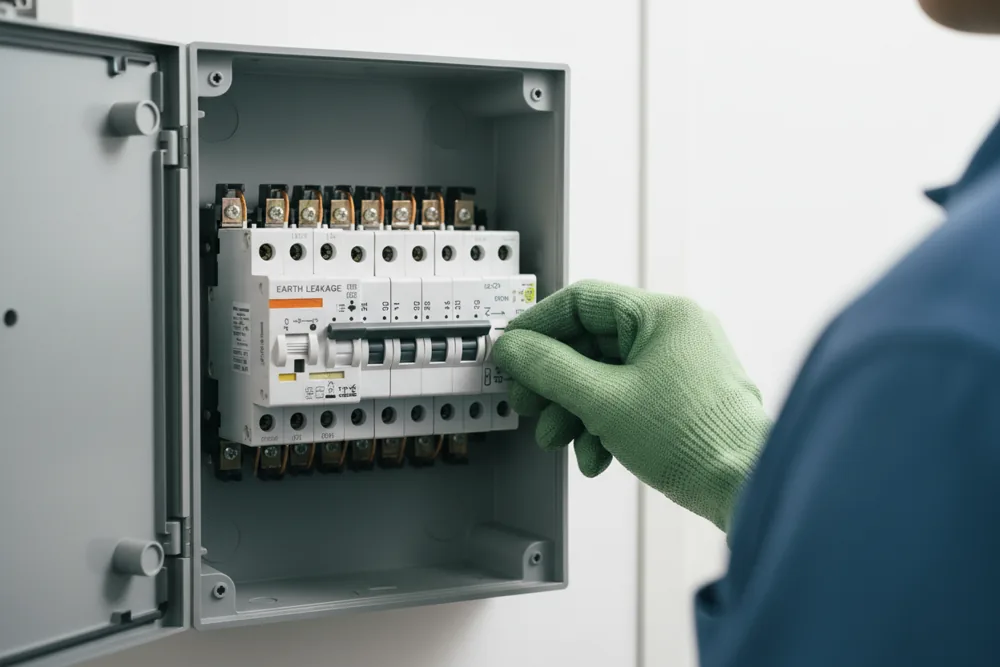
Heat, smell or a sound coming from the board
A burning smell, a breaker or faceplate warm to the touch, browning or blistering around a terminal, a buzzing or cracking sound, or visible scorching. Smoke or flame is SCDF on 995 first.
Do not reset. If you can identify the affected circuit safely from the outside of the board, isolate it and stop using it. Thermal damage in a distribution board means energy is being dissipated at a connection where it should not be, and every reset puts it back. This is what an out-of-hours emergency call-out is for.
A device that will not hold, or an RCCB that fails its test
A breaker that will not latch with its circuit completely disconnected, or a residual current circuit breaker that does not trip when you press its test button, is a real fault in the protection itself.
Neither is an emergency if nothing is warm and the rest of the property is working, and a daytime slot costs materially less. Leave the affected circuit off and book the next working day.
An old board, a full board, or a renovation coming up
No spare ways for the aircon, the induction hob or the EV charger you are about to install; a board of twenty-five years and up; or renovation work already scheduled.
This is a db box upgrade rather than a repair. It is also the case where getting the sizing right saves you paying for the same labour twice, see the sizing section below.
EMA’s own position: a working circuit breaker does not need replacing
This is the most useful thing on this page, and the one a quick sale would rather skip. The Energy Market Authority published a forum reply with the title “No Need to Replace Circuit Breaker If It Works”. The position is exactly what the title says: a breaker that is working does not have to be changed, and where a breaker is not working, the remedy is to engage a Licensed Electrical Worker to replace it.
That page ranks in the top handful of results for circuit breaker replacement Singapore. Not one commercial page on this search cites it. It is not hard to see why.
The practical consequence is a single question you can ask any electrician who recommends a replacement: which device failed, and on what test? "It is old" is not a test result. "It keeps tripping" is not a test result either, a tripped circuit breaker is usually a device doing its job against a fault that has not been found, which is why why the power tripped in the first place matters more than what is in the board.
Signs it is the board, and signs it is not
The board is genuinely the problem
Heat, browning or a burning smell at a terminal or breaker. Thermal damage in an enclosure is a board problem regardless of what caused it.
A breaker that will not hold with its circuit completely disconnected, nothing downstream left to blame.
An RCCB that does not trip on test. The protection is absent, which is worse than nuisance tripping.
Corrosion, moisture staining or crumbling insulation inside the enclosure, common where the board sits in a humid service area.
No spare ways and a new circuit to add. Not a fault, but a real reason to change the board.
The board is fine and something else is wrong
It trips when one appliance runs. That is the appliance. Water heaters, kettles and ageing air-conditioners lead the Singapore list.
It trips when it rains. Moisture reaching a ceiling light point produces enough earth leakage to operate an RCCB with nothing wrong in the board at all.
It trips under heavy load only. A circuit carrying more than it was designed for, or a supply still on the older 30A rating, see HDB electrical loading and the 30A to 40A upgrade.
Lights flicker but nothing trips. Usually a connection or a fitting, not the board, electrical fault diagnosis and repair covers the sequence.
Nothing is wrong at all. A board that has been reliable for fifteen years and passes its tests is not an upgrade waiting to happen.
Your RCCB may already have been fitted, free
Google asks “Is RCCB mandatory in Singapore?” on this search, and the answer has two dates that the ranking pages routinely collapse into one.
1985: residual current circuit breaker installation became mandatory for new domestic premises and whenever a property was rewired. That covers most housing stock built or renovated since.
1 July 2023: the requirement was extended to all HDB flats and private residences, closing the gap for older homes that had never been rewired. HDB began installing RCCBs in older flats from December 2022 under an exercise slated to run about two years, see HDB on residual current circuit breakers being required in all homes.
So before you pay anyone to fit an RCCB in an older flat: look at the board. If there is a device noticeably newer than its neighbours, wider than the row of MCBs, with a test button, it is likely already done. That is a Singapore-specific check worth sixty seconds, and no page on this search mentions it.
Can I replace an electrical box myself? Can I replace my circuit breaker?
Another live question on this search, and the pages currently answering it are overseas DIY guides describing a legal position that does not apply here.
In Singapore the line is clean. Outside the board is yours: looking at it, photographing it, resetting a switch that has tripped, isolating a circuit you have identified. Inside the board is a Licensed Electrical Worker’s, and that includes changing a single miniature circuit breaker, fitting an earth leakage circuit breaker, and replacing the enclosure.
Buying the hardware yourself does not move the line, and marketplace listings for boards and breakers rank on this very search, which is presumably why the question keeps being asked. You can supply the parts; someone licensed still has to install and test them, and they will want to know what they are being asked to certify. On what that licence actually authorises, see what a Licensed Electrical Worker is licensed to do.
What a distribution board replacement actually involves
A load survey first. What circuits exist, what they serve, what rating each needs, and what you are about to add. This is where the board gets sized, and it is worth more attention than the price.
Circuit identification. In an older flat the existing labelling is often wrong or missing entirely, and every circuit has to be traced and confirmed before anything is disconnected.
The swap itself: isolation at the main switch, the old board out, the new enclosure fixed, circuits transferred and terminated to torque, main switch and residual current circuit breaker fitted.
Then testing, which is the part that separates a board replacement from a board sale: insulation resistance, earth continuity, and a leakage test that proves the RCCB operates. Finally the board is labelled, which is what makes your next fault a twenty-minute diagnosis instead of an afternoon.
How long is the power off?
Nothing ranking on this search tells you, and it is usually the only logistical question that matters.
For a straightforward single-phase board swap in a flat, plan for the supply to be off for roughly the working part of a half day. The visit itself runs longer, because circuit identification happens before the outage and testing and labelling happen after it. Larger boards, three-phase supplies in landed property, and any surprise found in the existing wiring extend it.
Tell the electrician in advance if you work from home, have a freezer you would rather not empty, or have someone in the household using mains-powered medical equipment. Circuits can often be restored in stages so the property is not dark while the testing is done, and that is a planning decision, not an extra.
If the circuit stays on when I put it on another breaker, that's going to let me know the breaker is bad.
Sizing: 6-way, 12-way or 18-way
Published Singapore pricing steps by board size, so ways are the single biggest lever on what you pay, and the least costly thing to get right while the board is open anyway.
Count what you have: lighting, sockets, kitchen, water heater, and each air-conditioning circuit. Then count what is coming. An a home EV charger circuit wants its own way and its own protection. So does an induction hob, and so does water heater wiring work if the existing one is being moved.
Then check your supply rating, not just the board. A pre-1994 HDB block may still be on a 30A supply pending the Electrical Loading Upgrading Programme, which raises flats from 30A to 40A. A larger board on an unchanged 30A supply buys you ways, not capacity, and knowing which of the two you actually need is the difference between a useful upgrade and an expensive one.
S$380–780
DB box replacement by board size, 6-way to 18-way, published by fixmove.sg
S$350–480
DB box replacement in an HDB flat, published by Lito Electrical
S$650–800
DB box replacement in a condominium, published by Lito Electrical
What DB box replacement costs in Singapore
Published third-party ranges
S$380 / S$580 / S$780: DB box replacement from, by board size: 6-way, 12-way, 18-way (fixmove.sg).
S$350–480 HDB, S$650–800 condo, distribution board replacement (Lito Electrical).
~S$350–1,200+: distribution board upgrade depending on board size, breakers and testing (Yong Jin Electrical, June 2025).
S$320–800: DB box repair, circuit breaker box replacement or full board replacement (homejourney.sg, January 2026). S$400, advertised RCCB replacement (homeone.com.sg).
How to read them
These are published third-party ranges collected 18 August 2026, not a quote. The full source list sits on the sourced price ranges for Singapore electrical work page.
The spread is real, not noise: a 6-way like-for-like swap and an 18-way board with a new main switch, full testing and making good are different jobs wearing the same name.
Note what is missing from every one of those figures: none of them says whether testing, labelling, permit handling or repairs to the wall are included. That is the question to ask, and it is worth more than the headline number.
If the board is the reason you are here at all, the guide to call-out and minimum charges covers what the diagnosis visit itself costs.
How to read a DB box quote
A defensible quote for this work names six things. If yours names two, the rest are still going to happen, they are just not priced yet.
One, the board: make, number of ways, and how many are spare on completion. Two, the devices: main switch rating, the residual current circuit breaker, and each miniature circuit breaker with its rating. Three, the testing, insulation resistance, earth continuity and RCCB operation, stated as included.
Four, labelling of the finished board. Five, making good: who repairs the wall, and whether paint is included. Six, the permit position for your property type and scope, in writing.
And one line that is not a cost: the name and licence number of the Licensed Electrical Worker who will attend. You can check it yourself in about a minute, using the ELISE licence lookup.
Send a photo of your board and describe what it is doing
Get a DB box quoteWhy two quotes for the same board differ by a factor of two
Part of it is scope, as above. Part of it is timing, and Singapore has documented evidence of the size of that effect.
In a HardwareZone thread on a midnight breaker quote, a homeowner paid S$120 for an inspection at midnight and was quoted S$900 at around 1am to replace burnt circuit-breaker components. The next-morning comparison: S$50 to inspect and up to S$550 for the replacement. Reported spreads across similar threads run roughly 1.6x to 2.7x.
Out-of-hours pricing is not automatically unfair, unsocial hours and a single-visit callout cost real money, and one contributor to that thread defended the figure on exactly those grounds. But a distribution board that is stable, cool and not smelling of anything is one of the easier things to leave until the morning, and that decision is worth several hundred dollars.
HDB: check the loading before you size the board
HDB DB box replacement is single-phase, the board usually sits at the entrance, and the supply rating matters as much as the board. Published HDB db box price Singapore ranges sit below condominium ones for that reason. Like-for-like replacement is maintenance; new circuits, higher loading or hacking bring it under HDB renovation guidelines for electrical works.
If the flat trips rather than needing a board, start at tripping in an HDB flat and who pays, it may be common property and cost you nothing.
Condo: the MCST gets a say before anyone starts
Larger boards, more circuits, and published condominium ranges sit above HDB ones for exactly that reason. Management approval, permitted working hours and lift protection are all normal conditions, and they affect scheduling more than price.
The riser and the meter position belong to the development, not to you, which sometimes changes what is possible at the board.
Landed: often three-phase, and a bigger job
Three-phase supplies, sub-boards for outbuildings and pool or garden circuits make both the survey and the testing longer. Board sizing here is genuinely engineering rather than counting ways.
Landed properties are also where a board change most often reveals wiring that has outlived the board, see rewiring for landed and older homes.
Doing the board during a renovation
If a renovation is already happening, the board costs the least it ever will to change, because the disruptive parts: isolation, access, making good, are being paid for anyway.
Sequence matters. Board and circuit work belongs before carpentry, not after it: the most expensive late changes in Singapore renovations are consistently the ones where a circuit is discovered to be needed after the cabinetry is in. If the flat is old enough that the wiring is the real question rather than the board, rewiring an HDB flat and the lifespan of HDB wiring are the places to start. Buying rather than renovating? Electrical checks before buying a resale flat covers what to look at before you commit.
If it's not tripping, mechanically there's something wrong with the inside of it.
What to send to get a real number
Four things, and an electrician can often scope the price without attending:
A photo of the whole board with the cover on, and a second with the labels readable. Your property type: HDB flat and block age, condo, or landed. What is going wrong, or what you are adding.
That is usually enough to say whether this is a device, a board, or neither, and it is the difference between a diagnostic visit you pay for and a repair visit that fixes something. If it turns out nothing needs replacing, a good electrician will say so, which is the whole point of the EMA notice further up this page.
What this page does not claim
No fixed price before seeing the board. Every number on this page is a published third-party range with the source named, collected 18 August 2026. None of them is a quote for your property.
An earlier version of this page carried two prices with no source. They have been removed rather than re-attributed, because they could not be verified.
Be wary of a board replacement nobody can justify by test. If the device works, EMA’s position is plain: leave it alone.
DB box and circuit breaker FAQs
How much does it cost to replace a DB box in Singapore?
Published Singapore ranges for db box replacement price, collected 18 August 2026: fixmove.sg lists DB box replacement from S$380 for a 6-way board, from S$580 for 12-way and from S$780 for 18-way. Lito Electrical puts a DB box replacement at S$350–480 for HDB flats and S$650–800 for condominiums. Yong Jin Electrical quotes roughly S$350–1,200+ for a board upgrade depending on board size, breakers and testing, and homejourney.sg puts DB box repair or replacement at S$320–800. Those are third-party published ranges, not a quote. What moves a job through that spread is the number of ways, whether the supply and meter position need work, and how much testing and making good the board needs afterwards.
Can I replace my circuit breaker or an electrical box myself?
No. Google asks this on this search and the pages that rank answer it with overseas DIY guidance. In Singapore, any work inside the distribution board: swapping an MCB, changing an RCCB, or replacing the board, is electrical installation work restricted to a Licensed Electrical Worker under EMA rules. Resetting a tripped switch from the outside is not restricted and is fine. Opening the board is where it stops. Buying a board yourself from a marketplace listing does not change the position: someone licensed still has to install it.
My electrician says the breaker needs replacing. Does it?
Not necessarily, and there is a Singapore government source that says so plainly. EMA published a forum reply titled “No Need to Replace Circuit Breaker If It Works”: a working breaker does not need to be replaced, and if it is not working, engage a Licensed Electrical Worker to replace it. So the question to ask is which device failed, and on what test. A breaker that trips repeatedly is usually operating correctly against a fault that has not been found yet, and replacing it leaves you with the same fault and a smaller bank balance. A genuine failure looks like a device that will not hold with the circuit completely disconnected, or an RCCB that no longer trips when the test button is pressed.
Is RCCB mandatory in Singapore?
Yes, in every home. RCCB installation has been required since 1985 for new domestic premises and on rewiring, and from 1 July 2023 the requirement was extended to all HDB flats and private residences. HDB began fitting RCCBs in older flats from December 2022 under an exercise slated to run about two years, so if you live in an older flat there is a real chance one has already been installed at no cost to you. Worth checking your board before you pay anyone to fit one.
How long do circuit breakers last?
Longer than most quotes imply. The switches themselves are simple mechanical devices that spend their working lives doing nothing, and they rarely wear out. What ages in a distribution board is everything around them: terminals that have loosened and warmed through years of thermal cycling, insulation that has been cooked next to a hot connection, corrosion in a humid service space. That is why a board in a flat of twenty-five years and up earns an inspection while an individual breaker of the same age usually does not. The two genuine failure cases are a device that will not hold with its circuit fully disconnected, and an RCCB that no longer trips under test.
How long will my power be off while the board is replaced?
For a straightforward single-phase board swap in a flat, expect the supply off for roughly the working part of a half day, with the whole visit longer than that because circuit identification, testing and labelling sit either side of the outage. Nothing on this search states that, and it is usually the thing people actually need to plan around. Tell the electrician if you work from home, have a fridge full of food, or have someone in the household on mains-powered medical equipment: the sequence can often be planned around it, and in some cases circuits can be restored in stages.
How many ways do I need?
Count the circuits you have, then add for what you are about to install. A flat with lighting, sockets, kitchen, water heater and one air-conditioning circuit already fills a small board, and an EV charger, an induction hob or a second aircon system each want their own way. Published pricing steps by size: from S$380 for 6-way, S$580 for 12-way and S$780 for 18-way at fixmove.sg, so spare ways cost the least they ever will at the moment the board is being changed anyway. Filling a board exactly is how people end up paying for the same labour twice.
Do I need an HDB permit to replace a DB box?
Like-for-like replacement of a distribution board is maintenance rather than renovation, and normally does not need a permit: but the answer changes as soon as the job involves new circuits, higher loading, or hacking. HDB requires a permit for renovation involving electrical works, and adding 15A points in a flat that has not had its loading upgraded is a specific trigger. Since the work is a Licensed Electrical Worker’s in any case, ask them to confirm the permit position for your exact scope in writing before anything is ordered.
Why is one quote S$380 and another S$900 for the same board?
Some of it is real. A bigger board, a supply or meter position that needs attention, and proper testing and labelling all cost money that a bare board-swap price does not include. Some of it is timing: Singapore forum reporting shows spreads of roughly 1.6x to 2.7x between an out-of-hours quote and a next-morning one, including a documented case of S$900 quoted at around 1am against up to S$550 the following morning. The defence is boring and effective: get the scope in writing, ask which of the ways and which devices are included, and if the board is stable, ask for a daytime slot.
Related guides
 Blog
Blog
RCCB, ELCB and MCB explained
What each device protects, and which one is protecting a person.
Read more
Service
Why the power tripped
What each tripping pattern means before anyone replaces anything.
Read more
Blog
HDB electrical loading
The 30A to 40A upgrade, and why board size is not the same as capacity.
Read more Service
HDB rewiring
When the wiring, not the board, is the thing that has aged.
Read moreTell us what the board is doing
Send a photo of the whole board and a second of the labels, your property type and block age, and what is going wrong or what you are adding. We pass it to the electrician who takes the job, and that is often enough to scope a price without a site visit. A good electrician will tell you when nothing needs replacing.
Loading… if the form does not appear, contact us there instead.
If you see smoke or fire, call SCDF at 995 before anything else.
Island-wide
HDB, condo, landed and business premises
Test first
Ask which device failed, and on what test, before anything is changed
Check the licence
Ask the electrician for their name and licence number, then check it on ELISE
Been quoted for a new board? Send the quote and the board photo for a second read
Get a second opinionCitations
Sources for every figure on this page
Every figure quoted above is a published third-party number, not an estimate of ours. Where sources disagree, both are shown. Collected and last reconciled 21 August 2026.
-
That electrical installation work is restricted to a Licensed Electrical Worker, and what to ask before letting anyone start.
EMA: engaging licensed electrical workers , checked 21 August 2026
-
That a working circuit breaker does not need replacing, cited against the routine upsell.
EMA forum reply: “No need to replace circuit breaker if it works” , 2023
-
That residual current circuit breakers are required in all homes from 1 July 2023.
HDB Pulse: residual current circuit breakers required in all homes , 2023
-
Community reporting of after-hours quotes: cited as reported experience, not as a rate card.
HardwareZone forum thread: overcharged for a midnight breaker replacement , January 2023
-
Which electrical works in an HDB flat need approval, and the conditions attached.
HDB: renovation guidelines for electrical works , checked 21 August 2026
-
Published 2026 cost guide for distribution board repair and replacement.
HomeJourney: 2026 DB box repair and upgrade cost guide , January 2026
-
Breaker failure modes, and why “assume it is a bad breaker” is the wrong reflex. Cited for method only: US practice, not Singapore regulation.
Electrician U, Dustin Stelzer (US): “How to Tell if a Breaker is Bad”, cited for method only , published 12 July 2021
Published prices move. If a figure here no longer matches the source, the source wins, tell us and it gets corrected rather than quietly left to rot.
Last updated