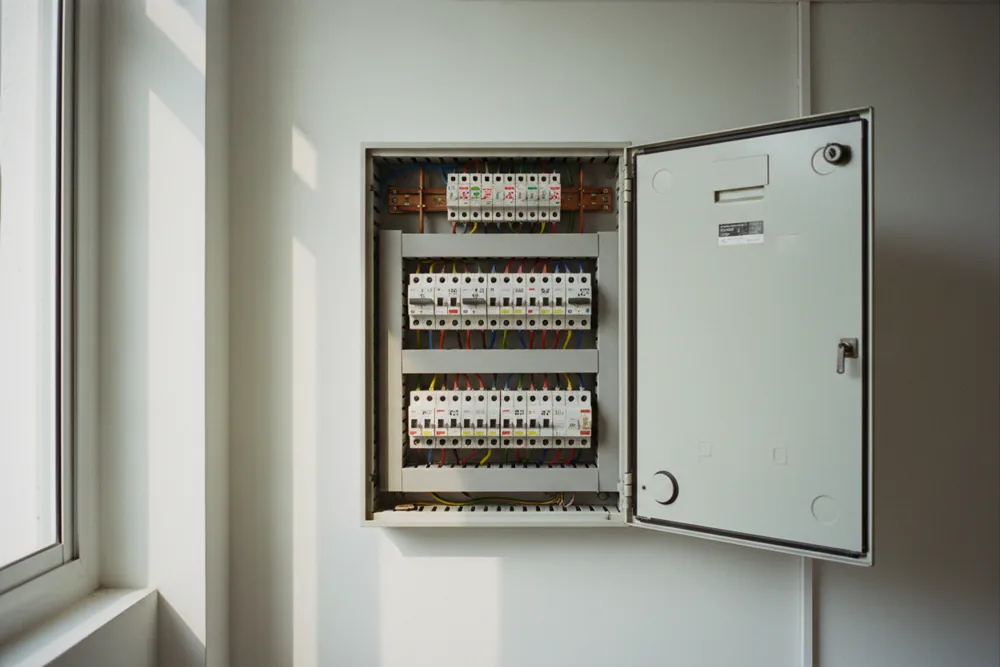
Which device tripped, and what it tells you
This is the practical value of knowing the difference,
and it is missing from every comparison page on this search. The device
that operated has already narrowed your fault for you.
An MCB tripped
Overcurrent on one circuit. Look at what was running,
several heavy appliances at once, or a genuine short in an appliance or
its lead. In an older block it can also be the supply rating rather than
a fault, which is
older-block supply capacity
territory.
The RCCB tripped
Earth leakage. The Singapore suspect list, in order:
a storage water heater with a degrading element, by
some distance the most common, and testable for free by isolating it for
a day, as
water heater circuits
describes; moisture, especially at a ceiling light point
after heavy rain; then ageing appliances and damaged insulation.
Everything went at once
Main switch, RCCB or supply. Before assuming it is your board, look down
the corridor, if neighbours are affected it is not your installation at
all, which is the subject of
working out who handles a power outage.
Nuisance tripping and the shared-RCCB problem
If one fault kills your entire flat, that is a board arrangement
problem rather than a mystery. Many Singapore boards run a
single RCCB covering every circuit, so any earth leakage anywhere takes
out everything, including the lighting you need to investigate it.
The remedy is splitting circuits across more than one protective device,
or RCBOs per circuit, so a fault isolates itself and the rest of the flat
stays live. That is a board upgrade decision rather than a repair, and the moment to
raise it is when a board is being changed anyway, or
during
a full HDB flat rewire,
where the board almost always gets replaced.
Does a tripping device need replacing?
Almost never. EMA’s published position is that a working
circuit breaker does not need replacing, and a device that keeps tripping
is usually doing its job against a fault nobody has found. Replacing it
leaves you with the same fault and a smaller bank balance.
Two genuine exceptions, both requiring a test rather than an opinion: a
device that will not hold with its circuit completely
disconnected, and a device that does not trip when its
test button is pressed. Everything else is diagnosis, evidenced by test results rather than opinion, see
power trip diagnosis and repair
and, if a device swap has been recommended to you,
verify the electrician's licence
before anyone opens the board.
What you may and may not do yourself
Yours: looking at the board, photographing it, pressing
the test button, resetting a device that has tripped, and switching a
circuit off. Not yours: anything inside the enclosure,
changing an MCB, fitting an RCCB, touching wiring or terminals. That is
electrical installation work restricted to a Licensed Electrical Worker
under
EMA’s rules on engaging licensed electrical workers.
Buying the device yourself does not move that line, which is worth
knowing given that most of the pages ranking for this comparison are
selling them.
What we do not claim
We do not publish a test frequency. Several sources
suggest one; we have not verified the exact official wording, and
inventing a number and attributing it to HDB or EMA is precisely the kind
of small error that makes a page untrustworthy.
We do not publish device ratings, sensitivities or product
recommendations. Those depend on the installation and are the
Licensed Electrical Worker’s to determine: and we do not sell components,
which is the main respect in which this page differs from every other
result on this search.