Rewiring · Guide · Updated 18 August 2026
HDB Wiring Lifespan: How Long It Actually Lasts
How long does hdb wiring last, answered from HDB’s own guidance rather than from a contractor’s estimate, and what the hdb wiring lifespan figure does not mean.
The short version
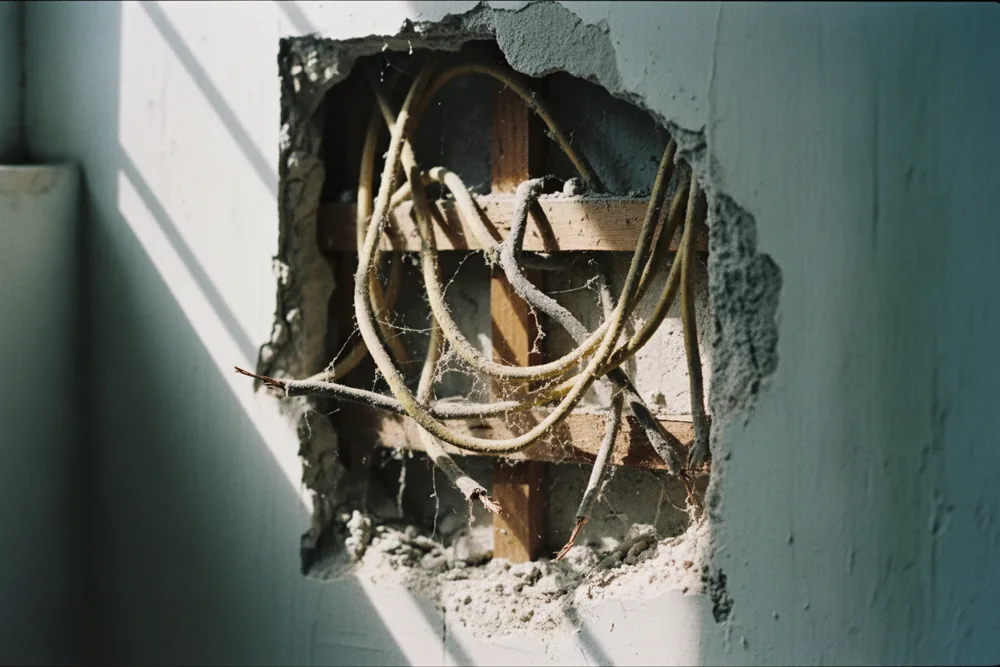
The sourced answer: HDB states that the estimated average lifespan of a PVC electrical cable is approximately 25 years. HDB also advises replacing the wiring when the lifespan is over or when conditions have deteriorated, two separate triggers. So age sets the presumption and condition settles it, which is why a 32-year-old flat that tests well may need nothing and a 20-year-old flat with heat damage may not wait.
What HDB actually says
The number everyone quotes has a source, and it is HDB’s own. Its home care guide states that a flat’s electrical wiring has a limited lifespan, and that the estimated average lifespan of a PVC electrical cable is approximately 25 years, see HDB’s home care guide for electrical accessories and wiring.
That page ranks first on Google for this question. Not one commercial page on the same results list cites it.
The second sentence everyone leaves out
HDB’s renovation guidance adds the part that changes the decision: you are advised to replace the electrical wiring in your flat when the life-span is over or when conditions have deteriorated, see HDB renovation guidelines for electrical works.
Two triggers, not one. Age is the easier of the two to check and the less informative. Condition is the one that decides, and the section below is about how it is actually established.
Why the other figures disagree
On this one results page you can find five different answers. 15–20 years. 20–25 years. HDB’s approximately 25 years. 25–40 years. And "50 years or more" for copper.
They are not all wrong; they are answering different questions. The 50-year figure is about the copper conductor, which does indeed last a very long time. The shorter figures are about the insulation around it, which is the part that actually degrades and the part HDB’s estimate refers to. When a page quotes a lifespan without saying whether it means the conductor or the insulation, that is the ambiguity it is hiding.
The imported ones to ignore
One ranking page lists lifespans for knob-and-tube and aluminium wiring. Those are American housing categories. They do not exist in HDB flats, and importing them makes an installation sound more exotic and more alarming than it is.
A design life is not an expiry date
Nothing happens on the twenty-fifth anniversary of your block. An estimated average lifespan is an engineering assumption about a population of cables, not a countdown on yours.
What it legitimately does is shift the burden of proof. Below it, an installation is presumed fine unless something says otherwise. Above it, it is worth testing rather than assuming. That is a materially different claim from "your flat is 30 years old, you need a rewire": and the difference is several thousand dollars, which is why the distinction gets blurred so often.
How condition is actually established
By measurement, and this is the half of HDB’s advice that no commercial page explains how to act on.
A Licensed Electrical Worker, the electrician Singapore homeowners should be asking for here, can carry out insulation resistance testing across the circuits, confirm earth continuity, and inspect the terminations at accessories and at the distribution board. That electrical inspection produces numbers and observations, not an opinion about how old your flat looks.
Testing first is the lower-cost decision
Testing an installation is a small fraction of the cost of replacing one. So when a rewire has been recommended and you are unsure whether you are being advised or sold to, asking for the test results first is both the reasonable response and the inexpensive one. A recommendation that cannot produce a measurement behind it is a recommendation worth a second opinion.
What ages first, and it is rarely the cable
The cable in the wall has the easiest life of anything in your installation. It sits at a stable temperature in a dry conduit and is never touched.
What ages faster is everything at the ends: terminations that have loosened through years of thermal cycling, accessories plugged and unplugged thousands of times, switches, the distribution board and its devices, and the earthing arrangement in installations old enough to predate current requirements.
Which is why a competent assessment looks at the accessories, the board and the earthing before it concludes anything about the cable, and why the answer is sometimes a breaker or DB box repair rather than a rewire at all.