Buying · Guide · Updated 18 August 2026
Resale HDB Electrical Inspection Before You Buy
A resale flat electrical check before buying Singapore buyers can actually do, and what to check during resale HDB inspection if you decide to pay someone.
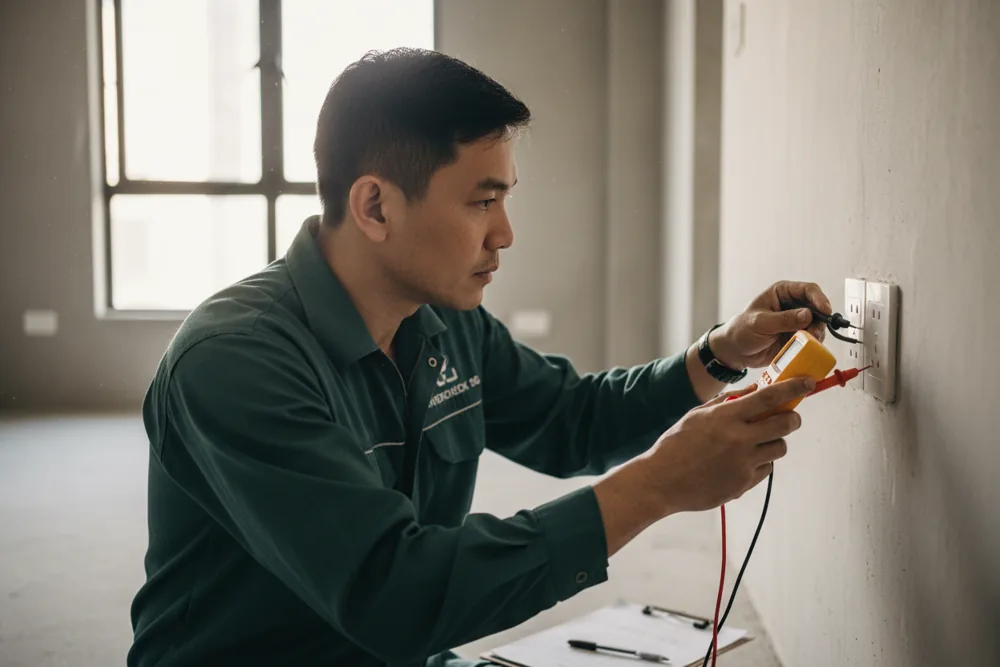
The short version
Do it before the Option to Purchase. Twenty minutes at the second viewing: open the distribution board and look for an RCCB, labelling and spare ways; check the accessories for scorching, cracks and looseness; look at where the trunking runs and what has obviously been added; and check the block’s electrical loading on HDB’s tool from your phone. After the OTP you own the findings. Before it, they are a negotiating position.
Do it before the Option to Purchase
This is the highest-leverage sentence on the page and no guide on this search says it.
Before the OTP you have alternatives, a seller who wants a deal, and the ability to renegotiate or walk. After it you have committed money and your position weakens sharply, which is precisely why the community threads ranking here are full of people discovering electrical problems after purchase rather than before.
Practically: do the visual check at the second viewing, and arrange any professional inspection in that same window. If an agent or seller resists a short inspection visit before the OTP, that resistance is itself information.
The twenty-minute check at a viewing
In priority order, because you will not get long and the first item tells you the most.
One: the distribution board
Open the cover if you can, photograph it either way. Look for: an RCCB, a larger device set apart from the row of MCBs, usually with a test button, and mandatory in all Singapore homes since 1 July 2023. Whether the board is a modern consumer unit or something visibly older. Whether the ways are labelled. And whether there are spare ways for the circuits your renovation will add, an induction hob, an extra aircon system, an EV charger.
What each device is and what its absence means: RCCB, ELCB and MCB roles explained.
Two: the accessories
Walk the flat and look at the sockets and switches. Scorching or browning around pin holes. Cracked or discoloured faceplates. Sockets that feel loose when you plug something in. And a patchwork of eras and brands, which usually means the installation has been extended piecemeal by several different hands over the years.
One scorched socket is a replacement. Several, across different rooms, is a pattern worth testing.
Three: the pattern of previous work
Where does the trunking run, and does it look planned or improvised? What has obviously been added, aircon points, extra sockets, a water heater? Does the work look like it was done by somebody who tested it afterwards, or by somebody who stopped when it worked?
And the question that follows from all of that, in the section below: what you cannot see.
Check HDB electrical loading for the block, in a minute
You can do this from your phone during the viewing, and no checklist on this search includes it. HDB publishes a HDB’s check electrical load of HDB block tool that tells you the block’s status.
It matters because loading decides what your renovation can contain and whether new 15A air-conditioner points need an HDB permit. HDB is upgrading about 1,500 older blocks from 30A to 40A by 2030, so a flat in the queue is not a problem, but it is a timing question. Detail in checking whether a block is due a load upgrade.
Compare the flat against its HDB floor plan
A trick that surfaces unauthorised alterations before you own them. HDB-approved floor plans can be obtained for a flat, and comparing one against what is physically in front of you is how you spot walls, wet areas and layouts that have moved.
For electrical purposes the useful version is simpler: does the position of points and fittings match a plausible original layout, or has a great deal been relocated? Heavy relocation is not automatically a problem: it is a prompt to ask who did it, whether it was permitted, and whether anything was concealed in the process.
Concealed electrical wiring HDB flats: is it illegal?
Google asks this on this search, and for a buyer it matters more than for anyone else. Published Singapore renovation guidance states that wiring installed in HDB flats must be exposed, and HDB renovation guidelines for electrical works govern what may be done in a flat. That is why a Singapore rewire looks like surface conduit and trunking rather than buried cable.
Why it matters to a buyer specifically
Because you inherit it. If a previous owner concealed wiring during a renovation, you acquire the installation and the question of what is behind the plaster. You cannot see it. The next electrician cannot easily test it. And the making-good cost of finding out is yours, not the seller’s.
What to look for: freshly plastered or recently painted walls in a flat with suspiciously few visible trunking runs, and points in positions that no surface route appears to reach. Ask. The answer, and the willingness to give one, both tell you something.