Sockets and points · Singapore
Power Socket Installation Singapore
The most-discussed thread on this search is a Singapore homeowner asking whether paying an electrician for a power point is any different from buying an extension cord and running the trunking themselves. That is the real question, and it deserves a real answer rather than a price list. So does the more awkward one: two of the pages ranking above this search tell you to install the socket yourself, and in Singapore that advice is wrong.
- Ask how circuit capacity was checked
- Check the electrician’s licence on ELISE
- Published price ranges, sources named
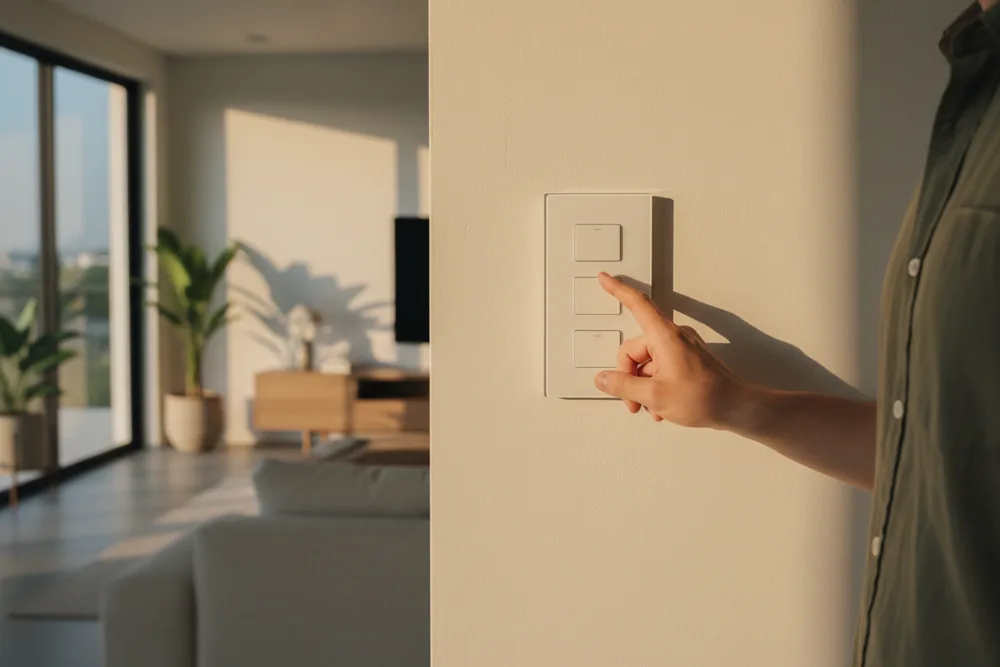
Power socket installation Singapore: two pages on this search tell you to do it yourself. Do not.
This is not a swipe at competitors, it is a correction of something checkable. On the first page of results for power point installation Singapore price and for residential power point installation Singapore sits an article walking readers through switching off the circuit breaker and fitting a new power point themselves, and another page stating that installing power points as a DIY project is possible, merely not recommended.
In this country, HDB states plainly that only a licensed electrician may replace socket outlets, see HDB’s home care guide for electrical accessories and wiring. Adding a socket outlet or a new circuit is electrical installation work restricted to a Licensed Electrical Worker under EMA’s rules on engaging licensed electrical workers. That is a legal position, not a recommendation, and DIY power point guidance written for jurisdictions where householder wiring is permitted does not travel.
People also search for how to change power socket Singapore, and the same answer applies to a swap as to a new point. If you have already read one of those guides and were about to open a faceplate: the useful part of what you learned still applies. Knowing which circuit feeds the point, and being able to isolate it, makes the visit shorter and less costly. The part that stops is the screwdriver.
Extension cord, or a real power point?
What an extension lead actually does
It moves a socket; it does not add one. Every appliance on the lead still draws through the same original point and the same circuit.
It concentrates load. Four appliances on one 13A outlet is how an overloaded extension cord starts warming.
It is designed to be temporary. Leads routed permanently behind furniture, under carpet or through doorways are a recognised fire risk, mechanical damage plus heat with nowhere to go.
Daisy-chaining multiplies the problem and removes any realistic idea of what the total load is.
It leaves with you. Nothing about the property has improved.
What a fitted power socket adds
The circuit gets assessed first. Capacity, protection and earthing are established before the point exists, which is the part you are actually paying for.
The connection is enclosed and terminated properly, not clamped into a moulded plug carrying four things at once.
It is tested: earth continuity, polarity, insulation resistance, and the circuit is labelled afterwards.
It is permanent and it is safe to be permanent, which is exactly what a trailing lead is not.
Where the load is real: aircon, water heater, kitchen appliances, anything running for hours: an extension lead is not an alternative, it is a hazard wearing the costume of one.
When an extension lead is genuinely fine
Worth saying, because a page that answers "always pay an electrician" to every version of this question is not answering it.
A lamp, a phone charger, a laptop, a fan, a router: small, intermittent loads on a good-quality surge-protected lead, plugged in where you can see it and unplugged when you are away for a month. That is a reasonable use of an extension socket and nobody needs to be called.
The line moves when any of four things is true: the lead has become part of the furniture, it disappears under a rug or behind a built-in, it feeds something with a heating element or a motor, or you find yourself plugging a second extension into the first. At that point you are not saving the cost of a point, you are deferring it at interest.
Can an electrician install a power point anywhere?
Google asks this on this search and no ranking page answers it. Broadly yes: but three real constraints decide the position, and they get settled on site rather than over the phone.
Water. Socket positions in bathrooms and immediately around sinks and hobs are restricted, and a point on a balcony, in a yard or anywhere exposed needs a properly rated weatherproof enclosure rather than an ordinary faceplate. An outdoor aircon power point is a specific version of this and is asked about often enough in Singapore forums to be worth planning rather than improvising.
Structure. HDB flats contain precast and structural walls that cannot be chased for a cable route. This is not an aesthetic preference, it is why so much Singapore work runs in surface trunking, and why the honest answer to "can it be concealed?" is sometimes no.
The circuit. A point is only as good as what feeds it. If the nearest circuit is already carrying its share, the correct answer is a new protected circuit from the board rather than one more spur, which is a distribution board question as much as a socket one.
Socket outlet replacement, the smallest job here
Like-for-like swap: a damaged, scorched or dated faceplate comes out and a new one goes in on the existing wiring. Published range for a 13A double socket replacement is S$60–120 at fixmove.sg, with a brand upgrade adding S$20–40.
Still restricted work, this is precisely the operation HDB names when it says only a licensed electrician may replace socket outlets. It is also the job where the wiring behind the plate gets looked at, which is half its value in an older flat.
A new point fed from a circuit that has room
The common case. A cable is run from a suitable existing circuit, usually in surface trunking, and a new point is terminated and tested. fixmove.sg publishes from S$80 for a single 13A point on a suitable existing circuit and S$120–220 for a new power point on trunking.
The word doing the work in that sentence is "suitable". Establishing that the circuit can take the addition is the assessment, and it is the reason a competent quote asks what you intend to plug in.
Its own circuit from the board
Air-conditioning, water heaters, induction hobs, EV charging and most 15A points want their own protected circuit rather than a spur. That means a way in the distribution board, its own miniature circuit breaker, and a longer cable run.
It costs more than a spur and it is the right answer more often than quotes admit. If the board has no spare ways left, this becomes a board conversation too, and wiring a water heater is the most common example in a Singapore flat.
15A points, aircon, and the HDB permit trigger
The permit question on this page has one specific answer worth remembering. An ordinary 13A point on an adequate circuit is normally the electrician’s licensed work and nothing more. A new 15A power point for an air-conditioner or another high-capacity appliance requires an HDB permit where the flat has not had its electrical loading upgraded.
That condition is still live across a lot of Singapore. Roughly 1,500 pre-1994 blocks are in the queue to be raised from a 30A to a 40A supply under HDB’s Electrical Loading Upgrading Programme, targeted for completion by 2030, the detail is in HDB electrical loading and the 30A to 40A upgrade.
The practical consequence: if you are adding aircon to an older flat, the loading question comes before the socket question, and aircon isolator requirements covers what the installer will expect to find. Anything involving hacking or new circuits falls under HDB renovation guidelines for electrical works.
S$120–220
New power point on surface trunking, published by fixmove.sg 2026
from S$80
Single 13A point on a suitable existing circuit, published by fixmove.sg 2026
S$80–120
Power point installation per point, published by getelectrician.sg 2026
Once all your bottom kitchen cabinets go up, it's very hard for the electrician to do any works, because it's already mounted and covered up.
Published Singapore prices, per point
Published third-party ranges
S$120–220, new power point on surface trunking; from S$80, single 13A point on a suitable existing circuit; S$60–120: 13A double socket replacement, brand upgrade +S$20–40 (fixmove.sg 2026).
S$80–120, power point installation per point (getelectrician.sg 2026).
S$40–80: call-out or minimum charge, plus about S$10 fuel surcharge per visit and roughly S$30 for an urgent slot.
What moves a point through that range
Cable run. Three metres of trunking from a nearby circuit and fifteen metres across a flat are not the same job, and distance is the single biggest variable.
Spur or dedicated circuit. A new way in the board, its own breaker and a longer route sit at the top of every range.
Trunking or concealed. Chasing, making good and repainting add labour that surface trunking does not.
Accessory type. Weatherproof, water-resistant, USB and smart faceplates cost more than a plain 13A double.
These are published third-party ranges collected 18 August 2026, not a quote. Full source list on the pricing page with its sources.
Why it is priced per point and not per hour
Google asks for the average hourly rate for electricians in Singapore, and the useful reply is that the question does not match the market. Residential electrical work here is quoted per point or per job, with a call-out or minimum charge on top for small visits.
That has one consequence worth acting on. The minimum charge is paid once whether you have one point installed or five. Published minimums run roughly S$40–80, plus about S$10 per visit as a fuel surcharge, and around S$30 more for an urgent or requested slot, the detail sits in the breakdown of call-out fees.
So walk the flat before you call. The bedside socket, the point behind the television, the one the kettle has been reaching for on an extension lead, the data point in the study: as one visit, that list is dramatically better value than four separate calls across a year. It is the advice a quick sale would skip, and it reduces what you pay.
Send your list of points and a photo of the wall with your enquiry
Get a per-point quoteThe room where extension leads do the most damage
Kettle, microwave, air fryer, rice cooker, oven: heating loads, often used simultaneously, frequently sharing one double socket through a multi-plug. This is where a dedicated circuit stops being a luxury.
An induction hob is a circuit, not a socket, and it needs deciding before the cabinetry is built, see the sequencing section below.
Small loads, but the points people miss
Bedside pairs, a cluster behind the television console, a point at desk height rather than at skirting level, and USB or smart faceplates where the load is genuinely trivial.
This is also where data and LAN points belong, smart switches and doorbell wiring covers what needs a neutral at the switch and what does not.
Where the accessory rating matters more than the position
Washing machines, water heaters, an outdoor aircon power point and anything on an open balcony need appropriately rated enclosures, and positions near water are constrained rather than free.
A weatherproof point costs more than a plain one and is not the place to economise; in a Singapore yard it is the difference between an accessory that lasts and one that fills with water.
Decide the points before the carpentry, not after
If a renovation is happening, points are the least costly thing on the job to get right and one of the most expensive to get wrong.
Qanvast’s reporting on Singapore renovation costs names three costly late mistakes, and all three are this page’s subject: data points outside the living room discovered after the fact, LED provision for carpentry not run before the cabinets went in, and induction hob wiring arriving after the kitchen was built. The same reporting notes that an electrical package typically represents about three-quarters of the final cost, with the balance arriving as a variation order, which is largely what afterthoughts like these are.
The fix costs nothing: walk each room with the furniture plan and mark where things will actually be plugged in, at the height they will be plugged in. If the flat is old enough that the circuits themselves are the question, start at a full HDB rewire instead, and if you are buying rather than renovating, a pre-purchase electrical checklist for resale flats lists what to look at.
When a socket needs replacing rather than adding to
Some of the calls that arrive as "I need another point" are actually "something is wrong with the one I have", and the signs are worth knowing.
Heat or scorching. Browning around the pin holes, a warm faceplate, a smell of hot plastic. A poor connection is dissipating energy inside the accessory.
A loose fit. A plug that falls out or sits at an angle makes intermittent contact, which makes heat. Sparking or buzzing at the moment of plugging in. Tripping when one thing is plugged in, which points at the appliance or at earth leakage rather than at the socket, see why the power tripped in the first place.
None of those wait for the next renovation, and none of them are a faceplate you should be opening yourself. Troubleshooting electrical faults covers the diagnostic side.
What a sound visit involves, and what should be tested
Survey first: where you want the points, what will be plugged into them, and which circuits are nearby and have capacity. This is where a point gets moved half a metre for a better route, and where a spur becomes a dedicated circuit.
Route and install: trunking or concealed run, back box, cable, termination. In an HDB flat the wall type frequently decides this rather than preference.
Then testing, which is what separates an installation from a fitting: earth continuity to the new point, correct polarity, insulation resistance on the circuit, and confirmation that the residual current circuit breaker still operates. Ask for the circuit to be labelled. If making good is not in your quote, ask whose job it is before work starts: it is the most commonly omitted line in Singapore socket quotes.
Verify the licence, and what to send
Ask for the name and licence number of the Licensed Electrical Worker attending. It takes about a minute to confirm on EMA’s public register, following the ELISE lookup walkthrough, or go straight to the ELISE licence register.
To help scope a quote before any site visit, send four things: a photo of each wall where a point should go, a photo of your distribution board with the labels readable, your property type and block age, and what will be plugged in. That last one is not curiosity, it decides spur versus dedicated circuit, and therefore most of the price.
I would say try and have more rather than not enough.
What this page does not claim
Every figure on this page is a published third-party range with its source named, collected 18 August 2026. None is a quote for your property.
An earlier version of this page listed per-accessory prices that could not be re-verified: a single point at S$65, a double at S$75, a 15A point at S$115 and a CAT6 data point at S$100. They have been withdrawn rather than restated, and the correction is recorded in the ground-truth file.
Be wary of a point quoted without knowing what feeds it. A per-point number given before anyone has established circuit capacity is a guess with a decimal place.
Power point and socket FAQs
How much does it cost to install a power socket in Singapore?
Published power socket installation cost ranges, collected 18 August 2026. fixmove.sg puts a new power point on surface trunking at S$120–220, a single 13A point on a suitable existing circuit from S$80, and a 13A double socket replacement at S$60–120 with a brand upgrade adding S$20–40. getelectrician.sg lists power point installation beginning at S$80 per point and rising to S$120. Those are third-party published ranges, not a quote. The gap between S$80 and S$220 is mostly cable run, whether the point goes on trunking or into the wall, and whether the existing circuit can take it.
Do you need an electrician to install a socket in Singapore?
Yes. HDB is explicit that only a licensed electrician may replace socket outlets, and adding a new point or a new circuit is electrical installation work restricted to a Licensed Electrical Worker under EMA rules. This matters more than usual on this particular search, because two of the pages ranking on page one for power point installation Singapore either give step-by-step DIY instructions or describe fitting your own power points as a reasonable project. That advice is written for jurisdictions where householder electrical work is permitted. Singapore is not one of them.
Is adding a power point the same as buying an extension cord and running trunking myself?
It is the most-discussed question on this search and the honest answer is that they solve different problems. An extension lead is a temporary convenience: it does not add capacity, it concentrates load at one existing socket, and permanently routed extension leads behind furniture or under floor coverings are a recognised fire risk in a way a fixed point is not. A properly installed power point is connected to a circuit that has been checked for capacity, terminated in an enclosure, earthed, tested and labelled, and it stays with the property. For a lamp and a phone charger, a good extension lead is genuinely fine. For an air-conditioner, a water heater, a kitchen appliance, or anything drawing serious current for hours, it is not.
Can an electrician install a power point anywhere?
No, and Google asks this on this search. Three things constrain it. Wet areas: sockets are restricted in bathrooms and near sinks and hobs, and anything outdoors or on an exposed balcony needs an appropriately rated enclosure rather than an ordinary faceplate. Structure: HDB flats contain precast and structural walls that cannot be chased, which is why so much Singapore work runs in surface trunking. Circuit: a point is only as good as the circuit feeding it, so a run that would overload an existing circuit needs its own protected circuit from the board rather than a spur. Within those limits the answer is usually yes, but the route and the method get decided on site.
Do I need an HDB permit to add a power point?
For an ordinary 13A point on an existing adequate circuit, usually not, it is the electrician’s licensed work rather than a permitted renovation. The trigger to watch for is a 15A power point for an air-conditioner or another high-capacity appliance, which needs an HDB permit where the flat has not had its electrical loading upgraded. Since roughly 1,500 pre-1994 blocks are in the queue to be raised from 30A to 40A under HDB’s loading upgrading programme, that condition is still live in a lot of older flats. Ask the electrician to confirm the permit position in writing for your exact scope before anything is ordered.
What is the average hourly rate for electricians in Singapore?
It is the wrong unit, which is worth saying because Google asks it. Singapore residential electrical work is overwhelmingly priced per point or per job, with a call-out or minimum charge on top for small visits: published sources put that minimum at roughly S$40–80, with about S$10 per visit as a fuel surcharge and around S$30 more for an urgent or requested time slot. A quote framed as an hourly rate for a socket is unusual enough here that it is worth asking what the total is going to be before anyone starts.
Is it worth adding several points in one visit?
Almost always, and this is where the per-point pricing model actually works in your favour. The call-out or minimum charge is paid once regardless, the circuit assessment is done once, and the trunking run that serves one point often serves three for a fraction more material. If you have been putting off a bedside socket, a point behind the television and a data point in the study, doing them together is the difference between paying three minimum charges and one. Walk the flat and write the list before you call.
Should I add data and LAN points at the same time?
If the wall or the trunking is being opened anyway, yes. Qanvast’s reporting on Singapore renovation costs names data points outside the living room as one of the three most common expensive afterthoughts, alongside LED provision for carpentry and induction hob wiring arriving after the cabinetry. All three are inexpensive while the route is open and disproportionately costly once it is closed. A CAT6 run to the study or the bedroom costs materially less added to an existing visit than commissioned on its own six months later.
My socket is warm, scorched or loose. Is that urgent?
Treat it as urgent rather than as a cosmetic problem. Heat, browning around the pin holes, a plug that fits loosely, a buzzing sound or a smell of hot plastic all point to a poor connection dissipating energy inside the accessory, and that is a recognised route to an electrical fire. Stop using it, switch off the circuit if you can identify it, and get it looked at rather than swapping the faceplate yourself. This is a replacement job rather than an additional-point job, and it should not wait for the next renovation.
Related guides
 Blog
Blog
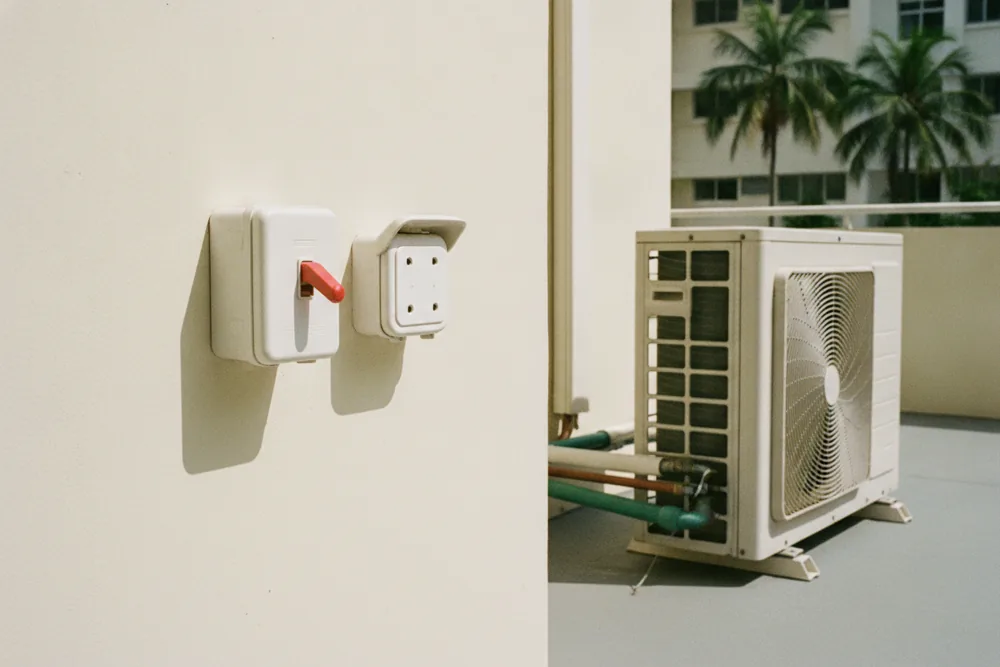
The aircon isolator and its point
What the installer expects to find, and who provides it.
Read more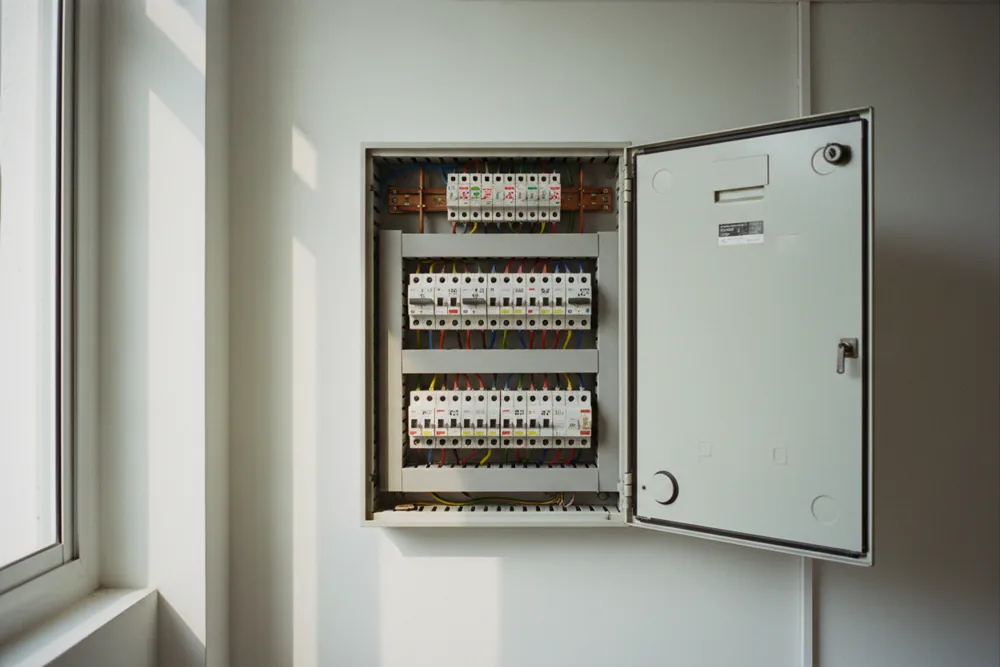 Blog
Blog
HDB electrical loading
The 30A to 40A upgrade, and why 15A points depend on it.
Read more Service
Lights and ceiling fans
Points overhead rather than at the wall, priced the same way.
Read more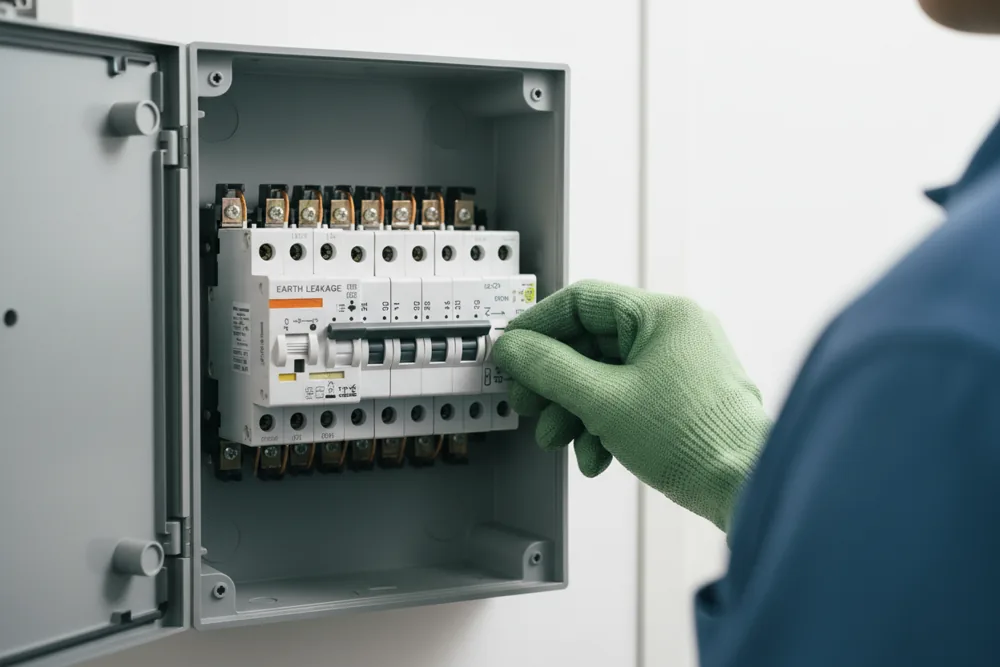 Service
Circuit breakers and DB boxes
When a new point needs a new way in the board.
Read moreTell us where the points go
Send a photo of each wall, a photo of your distribution board with the labels readable, your property type and block age, and what will be plugged in. Listing every point you want in one message is the single biggest thing you can do to reduce the total, the minimum charge is paid once.
Loading… if the form does not appear, contact us there instead.
If you see smoke or fire, call SCDF at 995 before anything else.
Island-wide
HDB, condo, landed and business premises
Circuit checked
Ask how capacity was assessed before a point is added, not after
Check the licence
Ask the electrician for their name and licence number, then check it on ELISE
Adding aircon to an older flat? Check the loading before the socket
Ask about your flatCitations
Sources for every figure on this page
Every figure quoted above is a published third-party number, not an estimate of ours. Where sources disagree, both are shown. Collected and last reconciled 21 August 2026.
-
HDB’s own maintenance guidance on electrical accessories and wiring condition.
HDB home care guide: electrical accessories and wiring , checked 21 August 2026
-
That electrical installation work is restricted to a Licensed Electrical Worker, and what to ask before letting anyone start.
EMA: engaging licensed electrical workers , checked 21 August 2026
-
Which electrical works in an HDB flat need approval, and the conditions attached.
HDB: renovation guidelines for electrical works , checked 21 August 2026
-
That the licence register is public, free and searchable before any work begins.
ELISE: EMA’s public licence register , checked 21 August 2026
-
Published 2026 Singapore price ranges for common electrical jobs.
-
A Singapore homeowner’s account of planning electrical points during a BTO renovation.
“Life with Maniac” (Singapore): planning electrical works in a 4-room BTO , published 23 April 2022
Published prices move. If a figure here no longer matches the source, the source wins, tell us and it gets corrected rather than quietly left to rot.
Last updated