HDB · Guide · Updated 18 August 2026
Town Council Electrician or Private: Who Does What
HDB town council electrical responsibility, in full: including the town council handyman services that work inside your flat, which most electricians’ websites never mention.
The short version
The boundary in one line: common property: corridors, staircases, lift lobbies, risers, is the town council’s and costs you nothing. Everything after your meter and inside your front door is yours. But there is a third option most electricians never mention: many town councils also run a paid handyman service that works inside flats, including electrical checks and MCB resets, in office hours.
The correction: town councils do work inside flats
An earlier version of this page said the town council’s remit stops at your front door. That was half the picture, and we are correcting it.
Two town councils rank at the top of this very search with published electrical services for residents. Tanjong Pagar Town Council lists an electrical service covering labour for checking defective wiring and fittings, including resetting of the MCB or consumer unit. Chua Chu Kang Town Council publishes a comparable minor-home-repairs service with its own contact number.
Almost no electrician Singapore website mentions this. The reason is not mysterious: it competes with them. It competes with us too, which is exactly why it belongs on this page.
What those services actually cover
Broadly, minor repairs: checking defective wiring and fittings, resetting an MCB or consumer unit, and in some cases supplying and fitting small accessories. They are the sort of thing that occupies half an hour and does not require diagnosis.
They are chargeable, the free half of a town council’s remit is common property, not your flat. Rates and exact scope vary by estate and are published by each town council, which is where to check them rather than here.
The hours that decide whether it helps you
This is the detail that turns it from interesting to useful. One of the town councils ranking here publishes opening hours of Mondays to Fridays, 8:00am to 5:00pm.
So: a genuine alternative for a Tuesday-morning fault. No help whatsoever at 11pm on a Saturday. If your problem is out of hours, the real choice is between isolating the affected circuit and waiting for Monday, often entirely reasonable, and paying out-of-hours rates to a private electrician, which the guide to out-of-hours call-out charges covers.
Where the free line sits
Free: common property. Chargeable: inside your flat, whoever does it. That single distinction resolves most of the confusion on this subject.
What is common property
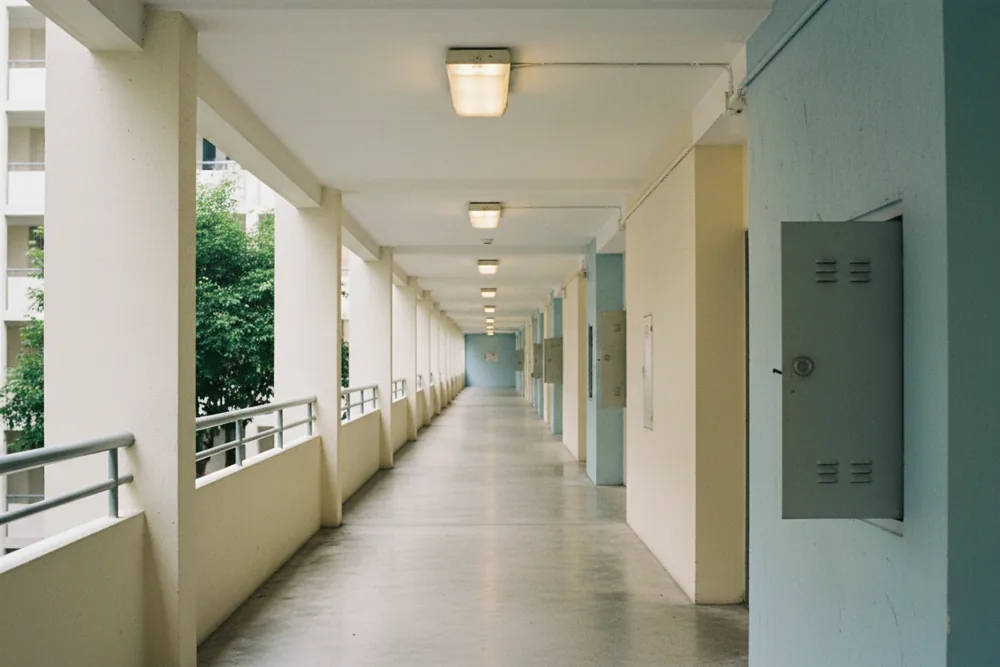
Corridor lighting and staircase lighting, lift lobbies, risers, and communal electrical services. Maintained by the town council and funded through service and conservancy charges: meaning you have already paid for it, and paying a private electrician to attend a corridor light is paying twice.
What is yours
Everything after your meter and inside your front door: the distribution board, the circuits, the accessories, the appliances. That is the owner’s responsibility, and work on it is restricted to a Licensed Electrical Worker under EMA’s rules on engaging licensed electrical workers.
And what is SP’s
The supply network up to and including your meter. If a whole stack or block is dark, that is SP Group’s to investigate and restore, and it is not charged to you, their Electricity Service Centre hotline is published as 1800 778 8888. Full routing in the guide to telling an SP outage from a flat fault.