Emergency Electrician SG

Outages · Guide · Updated 18 August 2026

Power Failure Singapore: Is It an SP Outage or Your Own Fault?

Power failure Singapore, answered from the front door: how to tell in sixty seconds, and who to call for power outage Singapore situations once you know.
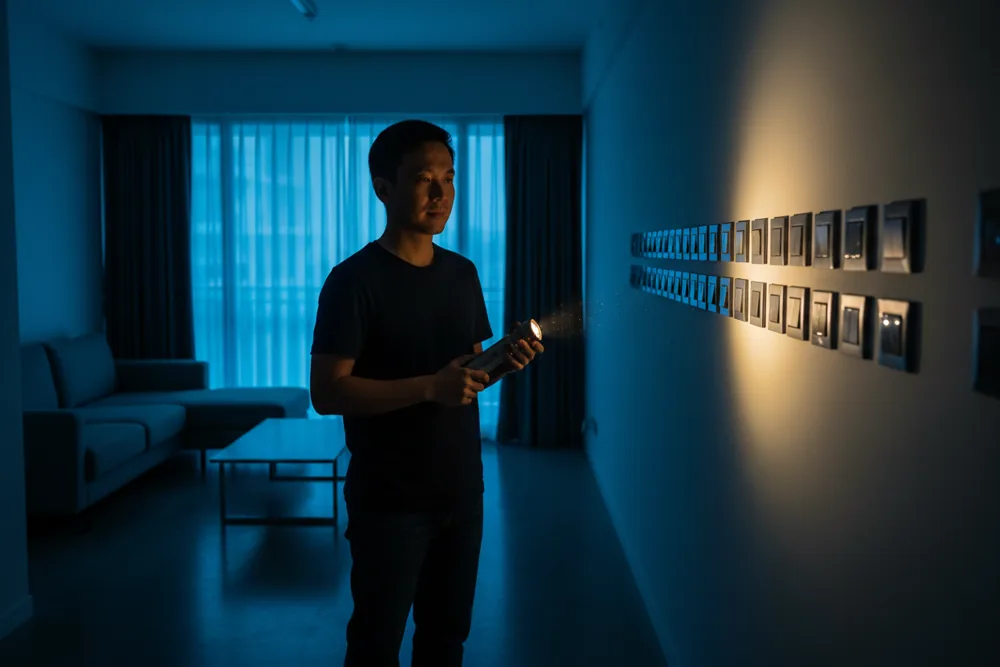
Person using a torch during a power outage in a Singapore flat

The short version

The sixty-second version: look down the corridor and out of the window before you call anyone. Corridor dark or neighbours affected → supply side, SP Group, published hotline 1800 778 8888, and not charged to you. Corridor lighting only → town council. Only your flat, something tripped in your board → your installation, and a licensed electrician. Nothing tripped but no power → almost certainly not yours either.

First: is it only you?

This is the only question that changes who you call, and it takes under a minute. Google asks it four different ways on this search: how do I check if there is a power cut in my area, how do I check for a power outage in my area, how do I know if there is no power in my area, how do you know if your power is cut, which is a strong sign nobody is answering it well.

The Energy Market Authority’s own public guidance uses the same order: assess first, then act. Three checks, in this sequence:

One, the corridor and stairwell. Are the common lights on? Two, your neighbours. A knock, or simply light under a door. Three, the block opposite. If a whole stack or block is dark, you have your answer without dialling anything.

What each answer means

Corridor dark, neighbours out, block affected: the fault is upstream of your meter: a supply outage, and restoration is SP’s job. Corridor or staircase lighting alone: common property, so the town council, more in choosing between the town council and a private electrician. Only your flat, and a device in your board has moved: your installation, and that is a power trip you can start diagnosing yourself.

Who to call, and what each number covers

Three different numbers cover three different problems, and using the wrong one costs you either time or a call-out fee.

SP Group for anything on the supply side. Their Electricity Service Centre hotline is published as 1800 778 8888, and it appears both on EMA’s tips on what to do during a power outage and in the outage resources ranking on this search.

995 or 999 for anything life-threatening or medical, EMA’s guidance names both, and it matters if someone in the home depends on mains-powered equipment. Your town council for common property. A licensed electrician Singapore residents can verify for faults inside your own flat. There is no HDB power outage hotline that sends someone into your flat, as who to call when an HDB flat trips covers the hdb power trip who to call routing at length.

Why the meter is the boundary

Everything before your meter belongs to the network and is SP’s to maintain and restore. Everything after it, the distribution board, the circuits, the accessories, the appliances, is your installation and your responsibility. That single line explains every routing decision on this page, and it is why the corridor check works: a fault before the meter almost never affects one flat alone.

If nothing in your board has tripped but you still have no power

That combination points away from your installation, not towards it. Protective devices only respond to conditions on your side of the meter. If none of them has moved and the flat is dark anyway, the most likely explanation is that electricity is not arriving.

One exception is worth knowing. In many blocks the meter and a main switch sit in a common riser compartment in the corridor rather than inside the flat, so there can be a tripped device you have not seen. That compartment can serve more than one household and it is not somewhere to start operating switches, note what you can see and let SP Group or a licensed electrician act.

How rare are Singapore outages, really?

Rarer than this page’s search volume suggests. SP Group has published that in 2016/17, customers experienced an average of 0.25 minute of electricity interruption across the year, with 98 per cent of interruptions restored within a stated window.

That figure is dated and we quote it with its year attached rather than as a current claim. But the order of magnitude is the useful part, and it has two consequences. First, a dark flat in Singapore is far more often an internal fault than a network one, which is why the corridor check saves so many wasted call-outs. Second, imported advice about preparing for days without power is describing a different country.

What a block outage actually means

In a high-rise, the electricity is not the hard part, the lift is. News coverage carries this and guidance pages never do.

In July 2026, residents of two Kim Tian Place blocks in Tiong Bahru were reported to be without electricity and lifts for close to three and a half hours, with some climbing up to 25 storeys. Separately, a failed backup generator was reported to have caused a roughly four-hour outage at Woodlands Checkpoint. Both are ordinary Singapore events rather than disasters, and both are longer than the average figure above would suggest.

Lifts, water and the top floors

If you live high up, the realistic preparation is not a stockpile. It is knowing that a block outage means stairs, that anyone with mobility difficulties in the household needs a plan rather than an assumption, and that while mains water pressure itself is not electrically dependent, buildings relying on pumped supply to upper floors can be affected while power is out. That is a building services matter rather than an electrical installation one, and it is the question actually worth asking your town council or managing agent.

Voltage dips: the outage that is not an outage

A voltage dip is a brief drop in supply voltage, long enough to disturb sensitive equipment, too short to be an outage. EMA tracks voltage dip incidents as a power-quality measure and publishes on the subject at EMA on voltage dip incidents, and yet essentially no consumer page explains what one feels like.

Why your equipment rebooted when the lights only flickered

This is what a dip feels like from inside a flat: the lights dim or flicker for a moment, and a computer, router, air-conditioner or induction hob restarts or throws an error, while everything else carries on as though nothing happened. Nothing in your board trips, because nothing in your board is designed to respond to a momentary voltage drop.

If it happens once, it is weather or a network event. If it happens repeatedly and always affects the same equipment, that is worth raising rather than accepting, and it is a different investigation from why lights flicker, which is usually a connection inside your own installation.

Checked the corridor and it is only your flat?

Get a licensed electrician

Checking whether there is an outage right now

This page cannot tell you that, and we are not going to pretend otherwise. A large share of the searches around power failure Singapore are live-event queries: today, live, update, map, news, and a guide written in August 2026 is the wrong instrument for them.

What to use instead: the corridor test above, which is faster than any website and answers the only question that changes your next action; SP Group’s published hotline; and news coverage for anything widespread. Third-party outage maps exist and rank well on this query, but treat them as indicative, they depend on reported data, and they cannot tell you whether the fault is on your side of the meter, which is the thing you actually need to know.

What causes supply-side failures here

Weather, equipment and works, in roughly that order of visibility. Lightning and heavy rain are the ones people notice, because the correlation is obvious. Underground cable faults and substation or transformer equipment failures account for a good deal of the rest and are invisible from a flat. Planned maintenance also exists and is normally notified in advance, which is why an unannounced outage is worth reporting rather than waiting out.

None of those is something a householder can act on, which is rather the point: if the cause is on the network, your job is to report it and wait, not to investigate.

What to do while the power is off

Keep the fridge shut, keep torches rather than phones as your light source, and switch off what was running.

A same day electrician cannot restore a network fault, and a daytime slot is the right booking once supply is back. A closed fridge or freezer holds temperature for a surprisingly long time; opening it to check is what costs you the food. A phone is your communication device and a poor torch, the five-minute preparation that actually pays off in Singapore is owning a torch you can find in the dark, not a generator.

If anyone in the household depends on mains-powered medical equipment, that changes the priority order entirely, and EMA’s guidance points to 995 or 999 for medical emergencies.

Before it comes back on

Switch off the appliances that were running when the power went. Not for drama, simply because everything in the flat restarting simultaneously the moment supply returns is an unnecessary surge of load, and because an unattended iron, hob or heater coming back on while nobody is watching is a genuinely bad idea.

If it turns out to be your installation

Then it is a power trip, not an outage, and the procedure is different. Work through the first steps after a trip: switch off and unplug the affected circuit, note which device operated, reset once, then restore appliances one at a time.

Which device tripped matters, what each breaker in your board protects against : and if it will not hold at all, power trip diagnosis and repair covers what a proper diagnosis involves. If the board itself is the problem, replacing a faulty breaker or DB box is the next step.

Costs, and who pays

Nothing, if the fault is SP’s. Where it sits upstream of your meter, the investigation and repair are theirs and are not charged to you.

What you can pay for is calling a power trip electrician Singapore homeowners find online to attend an outage that turns out to be supply-side, a call-out fee spent being told to call SP. Published Singapore ranges, collected 18 August 2026, put an ordinary-hours call out fee or minimum charge at roughly S$40–80, plus about S$10 per visit fuel surcharge and around S$30 more for an urgent slot. Those are third-party published figures rather than our rates, detail in the breakdown of call-out and urgent-slot fees.

Businesses, fridges and equipment

For commercial premises the calculation is different, because the cost of being dark is not the electrician’s invoice, it is the trading hours. Worth having settled in advance: who calls whom, what is on backup and what is not, and whether anything in the premises will fail badly rather than simply stop. Voltage dips matter more here too, since equipment that reboots at home is equipment that spoils a batch or drops a transaction in a business. Commercial and industrial electrical work covers the standing arrangements worth having.

What we do not claim

This is not a live outage map. We do not have real-time network data and would not publish it as though we did.

SP Group’s reliability figures are quoted with their 2016/17 date attached, because presenting a nine-year-old statistic as a current one is exactly the kind of small dishonesty that makes the rest of a page untrustworthy. Every price is a published third-party range with its source named, collected 18 August 2026, and none is our rate.

From the trade
Narrow it down, that's always the goal with fault finding.
Artisan Electrics , UK electrical contractor
What it means for you: Before anything else, establish the boundary: your unit, the stack, or the area. Everything outside your own installation belongs to SP or the town council, and is not billed to you.

Power failure questions

How do I check whether there is a power cut in my area?

Google asks this four different ways on this search, which tells you how much people want a definitive answer. Start with what you can see in sixty seconds, because it is faster than any website: are the corridor and stairwell lights on, do neighbouring flats have power, and is the block opposite lit? That tells you isolated or widespread, which is the only distinction that changes who you call. For confirmation, SP Group’s Electricity Service Centre hotline is published as 1800 778 8888, and EMA publishes guidance on what to do during an outage. This page is not a live outage map and will not pretend to be one.

Who do I call for a power outage in Singapore?

It depends which side of the meter the fault is on. If the corridor is dark, the stack is out, or several units are affected, it is supply-side: SP Group’s Electricity Service Centre hotline is published as 1800 778 8888, and where the fault is on their side the investigation and repair are not charged to you. If it is corridor or staircase lighting alone, that is common property and belongs to the town council. If only your flat is dark and something in your distribution board has tripped, the fault is inside your installation and needs a licensed electrician. EMA’s own guidance also notes calling 995 or 999 for life-threatening or medical emergencies, which is worth remembering if anyone in the home depends on mains-powered equipment.

Nothing in my board has tripped, but I have no power. What does that mean?

That combination is a strong pointer to a supply-side problem rather than a fault in your installation. Your protective devices only operate in response to something on your side of the meter; if none of them has moved and the flat is dark anyway, the electricity is probably not arriving in the first place. Check the corridor and your neighbours before calling anyone. The one exception worth knowing is that in many blocks the meter and a main switch sit in a common riser compartment in the corridor rather than inside the flat: so there can be a tripped device you have not seen, in a place you should not be operating yourself.

How often does the power actually fail in Singapore?

Less than the search volume suggests. SP Group has published that in 2016/17 customers experienced an average of 0.25 minute of electricity interruption across the year, with 98 per cent of interruptions restored within a stated window. That figure is dated and we quote it with its year rather than as a current claim, but the order of magnitude is the point: sustained domestic outages are genuinely uncommon here, which is exactly why a flat going dark is far more often an internal fault than a network one. It is also why imported advice about preparing for days without power does not fit Singapore conditions.

What is a voltage dip, and why did my equipment reboot when the lights only flickered?

A voltage dip is a brief drop in supply voltage: long enough to disrupt sensitive equipment, too short to be an outage. EMA tracks voltage dip incidents as a power-quality measure, and there is a government page devoted to them, but essentially no consumer guidance explains what one feels like. This is what it feels like: the lights dim or flicker for a moment, and a computer, router, air-conditioner or induction hob restarts or throws an error while everything else carries on as normal. Nothing in your board trips, because nothing in your board is designed to respond to it. If it happens repeatedly and affects the same equipment, that is worth raising rather than accepting.

What happens to the lifts and the water during a block outage?

This is where a block-level outage stops being an inconvenience and becomes a genuine problem, and it appears only in news coverage rather than in any guidance. In July 2026, residents of two Kim Tian Place blocks were reported to be without electricity and lifts for close to three and a half hours, with some climbing up to 25 storeys. Mains water pressure itself is not electrically dependent, but buildings that rely on pumped supply to upper floors can be affected while power is out. If you live high up, the practical preparation is knowing that and planning for the stairs, not stockpiling.

Do I get charged if it turns out to be SP’s fault?

Not for their side of it. Where the fault sits upstream of your meter, the investigation and repair are SP’s responsibility and are not charged to you. What you can be charged for is calling a private electrician to attend an outage that turns out to be supply-side, you will have paid a call-out fee to be told to call SP. Published Singapore call-out or minimum charges run roughly S$40–80, plus about S$10 per visit as a fuel surcharge and around S$30 more for an urgent slot. That is the entire economic argument for spending sixty seconds looking down the corridor first.

Where their side ends and yours begins
The ownership boundary: network, meter, your installation SP Group owns the network up to and including your meter. Everything past the meter, inside your unit, is your installation and your responsibility. Corridors, staircases, risers and lift lobbies are common property and belong to the town council or managing agent. SP Group Network up to and including your meter Meter the boundary Your installation Board, circuits, sockets, fittings: yours, and LEW work only Common property Corridors, staircases, risers, lift lobbies: the town council
Everything up to and including the meter is the network operator. Everything past it, inside your unit, is yours. Corridors and staircases are neither: they are common property.

Only your flat affected? That is an installation fault, not an outage

Book a diagnosis
If it is your installation, note what moved
What the device that moved tells you Three cases. If the main switch is off, everything downstream is dead and the whole installation is suspect. If the RCCB has moved, the board detected earth leakage, which is a protective device doing its job. If a single miniature circuit breaker has moved, the fault is confined to that one circuit, which is the easiest case to describe and the cheapest to diagnose. Before touching anything: note which switch is not where the others are Main switch The whole flat is dead. Everything downstream is off, so nothing narrows it down yet. Look outside first RCCB The board saw current leaking to earth and disconnected on purpose. Often one appliance. Protection worked One MCB The fault is inside a single circuit, and the rest of the flat is unaffected. Cheapest to diagnose A breaker that resets and holds is not proof the fault has gone. Note whether it held, and for how long.
Main switch, RCCB or a single MCB. That one observation is the most useful thing you can hand an electrician.

Citations

Sources for every figure on this page

Every figure quoted above is a published third-party number, not an estimate of ours. Where sources disagree, both are shown. Collected and last reconciled 21 August 2026.

  1. What to do during a power outage, including checking whether neighbours are affected.

    EMA media release: tips on what to do during a power outage , 2025

  2. Voltage dip incidents and how they are recorded, cited on supply-side symptoms.

    EMA: voltage dip incidents and enforcement decisions , checked 21 August 2026

  3. That electrical installation work is restricted to a Licensed Electrical Worker, and what to ask before letting anyone start.

    EMA: engaging licensed electrical workers , checked 21 August 2026

  4. The municipal reporting route for common-property faults.

    OneService: reporting municipal issues , checked 21 August 2026

Published prices move. If a figure here no longer matches the source, the source wins, tell us and it gets corrected rather than quietly left to rot.

Last updated

Electrical problem? Get help now