Home charging · Singapore
Home EV Charger Installation Singapore
Nearly every page ranking for home ev charger installation Singapore is written by somebody selling a charger. So the pages are about chargers, which is not what decides your price. Two things decide it, and both live in your house rather than in a product catalogue: how far your distribution board is from where the car parks, and whether that board has a spare way. This is the page that starts there.
- Ask for a survey before a price
- Ask for the LEW name, check ELISE
- Published price ranges, sources named
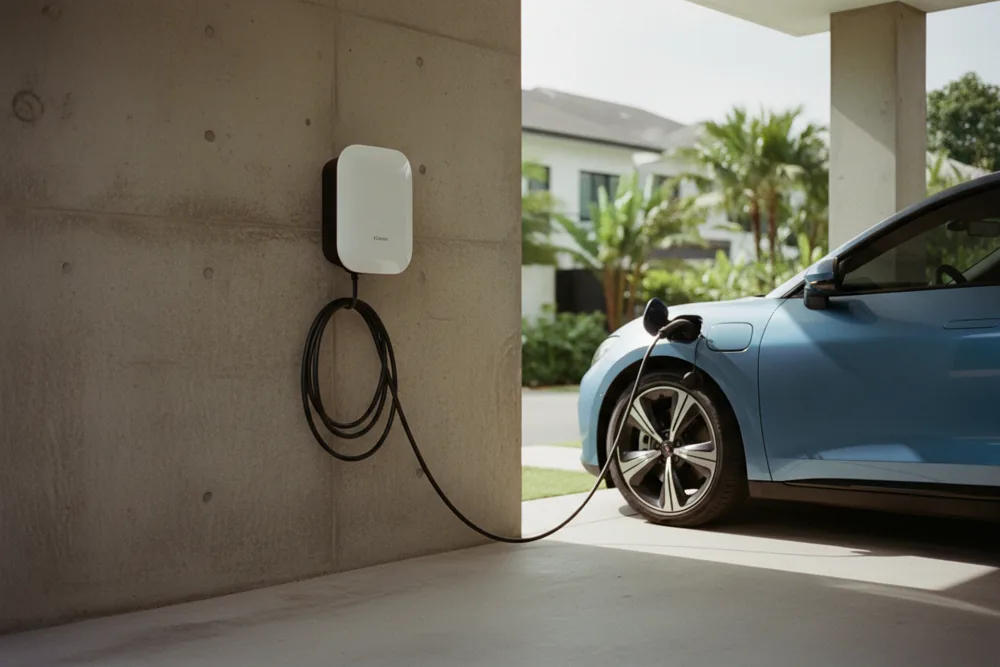
The two things that actually set your price
Distance from board to car
The charger takes minutes to hang on a wall. Getting a correctly sized, protected circuit to where the car actually parks is the job.
Measure the route, not the straight line. Around the door frame, up over the beam, along the eaves: that is the cable run, and it is usually longer than people guess.
What adds cost: external runs needing weatherproofing, walls to penetrate, ground to cross, and anything that turns a surface run into a buried one.
Tesla publishes S$1,500–3,500 for standard installation excluding the unit, with total distance up to 30m. It is the only figure on this search that names its scope, and that is exactly why it is the useful one.
What the board has left
A charger wants its own protected circuit from the distribution board. It is a sustained, high-current load running for hours, not something to spur off an existing circuit.
So the first question is whether there is a spare way, and the second is whether the supply into the property has headroom.
If the board is full: a sub-board, a board replacement, or a charger with load management that works within what you already have.
Published board work runs S$320–800, or from S$380 for a 6-way board, see board upgrade and DB box costs. Discovering it during the survey is inconvenient; discovering it on installation day is expensive.
What LTA requires, in order
This sequence is barely covered by the pages selling chargers, and it is the part with deadlines attached.
One: type approval. New EV chargers must be type-approved by LTA before they can be installed, certified and registered. So the model you choose is a compliance decision before it is a preference, see LTA’s registration of EV chargers page.
Two: installation and certification, after which a Certificate of Fitness is issued. That certificate must be provided at registration, which is one reason a self-installation is a dead end.
Three: registration. You may use the charger immediately once registration succeeds, but the registration mark must be affixed within 60 days. Four: ongoing. At non-restricted access locations, periodic inspection every 12 months by a Licensed Electrical Worker is required.
Responsibility splits cleanly: the charger owner handles registration and maintains the certifications; the supplier is responsible for ensuring the approval label is affixed before supply.
LTA fees: we are sending you to the source, and here is why
Most pages would quietly publish a number here. We are not going to, and the reason is worth reading because it tells you something about how to read everyone else’s numbers.
An earlier version of our EV pages stated a S$35 application fee for registration. We later found that LTA attributes S$35 to transfer and relocation, corrected the page, and recorded the error. Re-checking in August 2026, LTA’s current page summary appears to reference an application fee again, in a sentence we cannot read in full without going to the page itself.
Two wrong readings of one number is enough. Go to LTA’s registration of EV chargers page and read the fees there. LTA has stated registration fees are unchanged until 31 March 2027, so what you read will hold for a while. If an installer quotes you a regulatory fee as part of their price, ask them to show you where it comes from.
Can I install my own EV charger?
A Singapore EV owners’ group thread asking exactly this ranks on this search, alongside another asking for installer recommendations. The answer is no, and unusually there are two independent reasons rather than one.
The electrical reason: connecting a charger to your fixed wiring is electrical installation work, restricted to a Licensed Electrical Worker under EMA’s rules on engaging licensed electrical workers. That alone settles it.
The LTA reason: the installation must be certified, a Certificate of Fitness issued, and the charger registered. A self-installation cannot produce any of that. So even setting the law aside, a DIY charger is an unregistered charger, which is a problem for insurance, for resale of the property, and eventually for you.
S$1,500–3,500
Standard installation excluding the unit, total distance up to 30m: published by Tesla Singapore
S$1,500–3,000
Charger unit; installation S$800–2,000: published by ElectGo 2025
12 months
LTA periodic inspection interval by a LEW at non-restricted access locations
Published Singapore prices
Published third-party figures
S$1,500–3,500: standard installation service excluding the Wall Connector, total distance up to 30m (Tesla Singapore support).
S$1,500–3,000 charger unit and S$800–2,000 installation fee, with load balancing and extended runs named as cost drivers (ElectGo, May 2025).
S$2,000–8,000 total, averaging around S$3,500 (getelectrician.sg).
S$320–800 distribution board work, or from S$380 for a 6-way board, where the board needs attention (homejourney.sg, fixmove.sg).
How to read them
Separate the unit from the installation. They are two purchases and often two suppliers, and a single "total" hides which half is moving.
A price without a distance is not a quote. Tesla’s figure is the only one on this search that states its scope, which is why it is the one worth benchmarking against.
Board work sits outside all of these ranges. If your board is full, that cost is additional and every published total quietly assumes it is not.
These are published third-party ranges collected 18 August 2026, not our rates, full list on the sourced pricing summary.
Send a photo of your board and the distance to your parking space
Get a scoped quoteIt's pointless to put a 22 kilowatt charger in.
What the site survey actually checks
Every ranking page says a licensed installer should assess the site. None of them says what is being assessed, so here is the list.
The incoming supply and main switch, what the property is fed with, and whether there is headroom for a sustained additional load. The distribution board: spare ways, condition, protection, and whether it is labelled well enough to work on safely.
The route: where the cable can physically go, what it passes through, whether it needs weatherproofing or mechanical protection, and how it will be contained. The charger position, reachable from the car in both parking directions, protected from being driven into, and the cable long enough without being a trip hazard.
And the paperwork position: property type, management or MCST approval where applicable, and whether the chosen charger model is type-approved. A survey that skips that last item is storing up a problem for registration day.
The simplest case, because it is all yours
The board, the cable route and the parking space all belong to you, so the only constraints are physical and electrical. This is where install ev charger at home is genuinely a one-visit job, assuming the board has capacity.
Watch for: long runs from a board at the front of the house to a car port at the back, and older properties where the supply and board predate the idea of charging a car overnight, see rewiring an older landed home.
MCST approval sets the timeline
The riser, the meter position and the supply capacity belong to the development. Expect to submit the installer’s details and insurance, the charger model and a proposed cable route, and expect that to take calendar time rather than money.
Start that conversation before ordering the charger. A type-approved unit sitting in a box while an application is considered helps nobody.
A different question entirely
Google asks how much does HDB EV charging cost on this same search, but that is about public charging points in HDB carparks operated by charging companies, not about installing a private charger at a flat. The two get conflated constantly and they are not the same decision.
If that is your situation, EV charging in HDB and condo carparks covers it properly rather than pretending a private point can go into a public carpark.
Which charger, from the installation side, and is there an LTA approved EV charger list?
Two of the questions Google attaches to this search ask which charger is best. We do not sell chargers, so rather than a ranking, here is what the choice changes for the person wiring it in.
People look for an LTA approved EV charger list; what matters is that type approval is a hard filter coming before preference: if LTA has not type-approved the model, it cannot be installed, certified or registered, whatever its reviews say.
A 7kW AC single-phase wallbox is the typical Singapore home unit and suits an ordinary domestic supply. Tethered or untethered decides whether a cable lives on your wall permanently. Weatherproof rating matters in a car porch, which is outdoors whatever it feels like.
And ask specifically about load management. A charger that can moderate its own draw against the rest of the house may let you avoid a board or supply upgrade, a saving that dwarfs the price difference between two units, and one no charger review will frame for you that way.
Charging cost, and should I charge my EV to 100 every night?
Two more of Google’s questions here are about what charging costs and whether to charge to 100% every night. Neither is really an electrician’s question, so brief and honest answers.
On cost: home charging is billed through your own electricity supply at your own tariff, which is why it is generally the least expensive way to charge and why the comparison against public charging depends entirely on your tariff and the operator’s rate. We are not an energy retailer and will not publish a per-kWh comparison we cannot keep current.
On charging to 100%: that is a battery and vehicle question, and your manufacturer’s guidance is the answer that matters. The installation-side version is simply that a charger with scheduled charging lets you control when charging happens, useful if your tariff varies by time of day. Specify it before installation; it is a charger feature, not something an electrician can add afterwards.
Testing, handover, and the inspection nobody mentions at the point of sale
What should exist when the installer drives away.
Test results: insulation resistance, earth continuity and confirmation that the protective devices operate. The Certificate of Fitness from the certification step. Registration completed, with the registration mark affixed within 60 days. A labelled board showing the new circuit. And the name and licence number of the Licensed Electrical Worker responsible, then verify it on ELISE.
Then the ongoing obligation almost nobody mentions while selling you a charger: at non-restricted access locations, periodic inspection every 12 months by a Licensed Electrical Worker. That is a recurring cost and a recurring appointment, and it is much better known about on day one than discovered in year three.
What to send us for a quote
Five things, and the electrician who takes the job can give a scoped price rather than a range copied off a website.
A photo of your distribution board with the labels readable. A photo of where the car parks and of the wall the charger would go on. The route distance: walked, not estimated in a straight line. Your property type: landed, condo, or something else. The charger model, if you have already chosen one.
One sequencing tip that saves money: have the survey before you buy the unit, not after. It is the only order in which the load management question can still save you a board upgrade.
What we do not claim
No LTA fee figures. Explained above, this specific number has produced two conflicting readings and we are not attempting a third.
No breaker rating or cable size. They depend on the charger and the installation and are the LEW’s to determine at survey. Anyone quoting a rating before seeing your board and your charger is guessing.
No claims about which chargers are on LTA’s approved list, and no response-time promise. Both would need to be verified and maintained, and one of them needs a signed operator.
Home EV charger FAQs
How much does it cost to install an EV charger at home in Singapore?
Published Singapore figures, collected 18 August 2026, with the unit and the installation separated because they are separate purchases. Tesla’s Singapore support pages state it may cost SGD 1,500–3,500 for standard installation service excluding the Wall Connector, with total distance up to 30m. ElectGo puts the charger unit at S$1,500–3,000 and the installation fee at S$800–2,000. getelectrician.sg puts the all-in total at S$2,000–8,000 with an average around S$3,500. None of those is our rate. Notice what the Tesla figure does that the others do not: it names a distance limit. Distance is the single biggest variable, which is why a home ev charger installation Singapore price quoted without one has not been scoped.
Why does the distance to my parking space change the price so much?
Because the cable run is most of the job. The charger takes minutes to fix to a wall; getting a correctly sized, protected circuit from your distribution board to where the car actually parks is the work. A board in the utility room and a car three metres away is a straightforward morning. A board at the front of the house and a car port at the back, with a wall to penetrate, an external run to weatherproof and possibly a trench to cross, is a different job entirely. Tesla’s published installation range covers total distance up to 30m for exactly this reason. Measure the route: not the straight line, the route the cable would actually take, before you ask anyone for a price.
What if my distribution board has no spare way?
Then there is a board job hiding inside your charger job, and it is better to find it in the survey than on installation day. An EV charger wants its own protected circuit from the board: it is a sustained, high-current load running for hours, which is not something to hang off an existing circuit. If the board is full, the options are a sub-board, a board replacement, or in some cases a smart charger with load management that lets the installation work within your existing capacity. Published ranges put distribution board work at S$320–800, or from S$380 for a 6-way board. Send a photo of the board with the quote request and this stops being a surprise.
What does LTA require for a home EV charger?
Four things, and they run in order. New EV chargers must be type-approved by LTA before they can be installed, certified and registered, so the model matters before anything else. After installation and certification, a Certificate of Fitness is issued and must be provided at registration. Once registration succeeds you may use the charger immediately, but the registration mark must be affixed within 60 days. And at non-restricted access locations, periodic inspection every 12 months by a Licensed Electrical Worker licensed by EMA is required. Responsibility for registration and for maintaining certifications sits with the charger owner; the supplier is responsible for ensuring the approval label is affixed before supply.
What are the LTA fees?
We are deliberately not printing a dollar figure here, and it is worth explaining why rather than just omitting it. This specific number has already caused one published error on this site: an earlier version of our EV pages stated a S$35 application fee for registration, which we corrected after finding LTA attributes S$35 to transfer and relocation. The current LTA page summary appears to reference an application fee again, in text we cannot read in full without going to the page. Rather than guess a third time, go to LTA’s Registration of EV Chargers page and read the current fees there: LTA has stated that registration fees are unchanged until 31 March 2027, so what you read will hold for a while.
Can I install my own EV charger at home?
No, and there are two separate reasons rather than one. First, connecting a charger to your fixed wiring is electrical installation work, which in Singapore is restricted to a Licensed Electrical Worker under EMA rules. Second, and specific to EV chargers: the installation has to be certified, a Certificate of Fitness issued, and the charger registered with LTA, none of which a self-installation can produce. This question comes up regularly in Singapore EV owner groups, and one such thread ranks on this very search. The honest answer is that even if you have the skills, you cannot produce the paperwork, and the paperwork is what makes the installation legal and insurable.
Which home EV charger should I buy?
We do not sell chargers, so instead of a ranking, here is what the choice changes for the installation. The unit must be type-approved by LTA, that is a hard filter and it comes before preference. A 7kW AC single-phase wallbox is the typical Singapore home unit and suits a normal domestic supply. Tethered versus untethered decides whether a cable lives on your wall. Weatherproof rating matters if the charger is outdoors, which in a car porch it usually is. And load management is worth asking about specifically, because a charger that can moderate its draw may let you avoid a supply or board upgrade, which is a much larger cost than the difference between two charger models.
Does my condo need MCST approval?
Yes, in practice always, and it is the step that sets your timeline rather than your price. In a condominium the riser, the meter position and the supply capacity into your unit or lot belong to the development, not to you, so both the electrical route and the parking location are subject to management approval. Expect to submit the installer’s details and insurance, the charger model, and a proposed cable route. Landed property is the simplest case for exactly the inverse reason: the board, the run and the parking space are all yours. Start the management conversation before you order the charger, not after.
Should I charge my EV to 100% every night?
Google asks this on this search, so briefly, and then honestly about the limits of our expertise: this is a battery and vehicle question rather than an electrical installation one, and the manufacturer’s guidance for your specific car is the answer that matters. What we can tell you is the installation-side version. A charger with scheduled charging lets you decide when charging happens rather than only whether it happens, which matters if your tariff varies by time of day and matters for how long the circuit is loaded. If you want that flexibility, specify it before installation: it is a charger feature, not something an electrician can add afterwards.
Related guides
Service
EV charger installation
The wider service, including commercial and multi-point installations.
Read more Blog
Blog
EV charging in HDB and condos
Public carpark charging, and what is actually possible where you live.
Read more Service
Boards and circuit breakers
What happens when there is no spare way for the charger.
Read more Service
Check a licence on ELISE
Verify the individual taking charge, in about a minute.
Read moreTell us about the board and the parking space
Send a photo of your distribution board with the labels readable, a photo of where the car parks, the walked route distance, your property type, and the charger model if you have chosen one. Have the survey before you buy the unit, it is the only order in which the load management question can still save you a board upgrade.
Loading… if the form does not appear, contact us there instead.
If you see smoke or fire, call SCDF at 995 before anything else.
Island-wide
Landed homes, condominiums and business premises
Survey first
Ask for the board, supply and cable route to be assessed before a price
Check ELISE
Ask for the LEW name and licence number, then verify it
Bought the car already? Get the survey done before you order the charger
Ask for a site surveyCitations
Sources for every figure on this page
Every figure quoted above is a published third-party number, not an estimate of ours. Where sources disagree, both are shown. Collected and last reconciled 21 August 2026.
-
EV charger registration requirements in Singapore.
LTA: registration of EV chargers , checked 21 August 2026
-
That electrical installation work is restricted to a Licensed Electrical Worker, and what to ask before letting anyone start.
EMA: engaging licensed electrical workers , checked 21 August 2026
-
A published Singapore homeowner guide to home EV charger selection.
-
Supply capacity as the feasibility gate, and cable route as the price driver. Cited for method only: UK practice, not Singapore regulation.
Artisan Electrics (UK): EV charge point installation, cited for method only , published 3 March 2025
Published prices move. If a figure here no longer matches the source, the source wins, tell us and it gets corrected rather than quietly left to rot.
Last updated