EV charging · Guide · Updated 18 August 2026
Install EV Charger at Home: What HDB and Condo Actually Allow
EV charging hdb carpark condo Singapore, answered from the supply side, including the question everyone asks and nobody answers electrically.
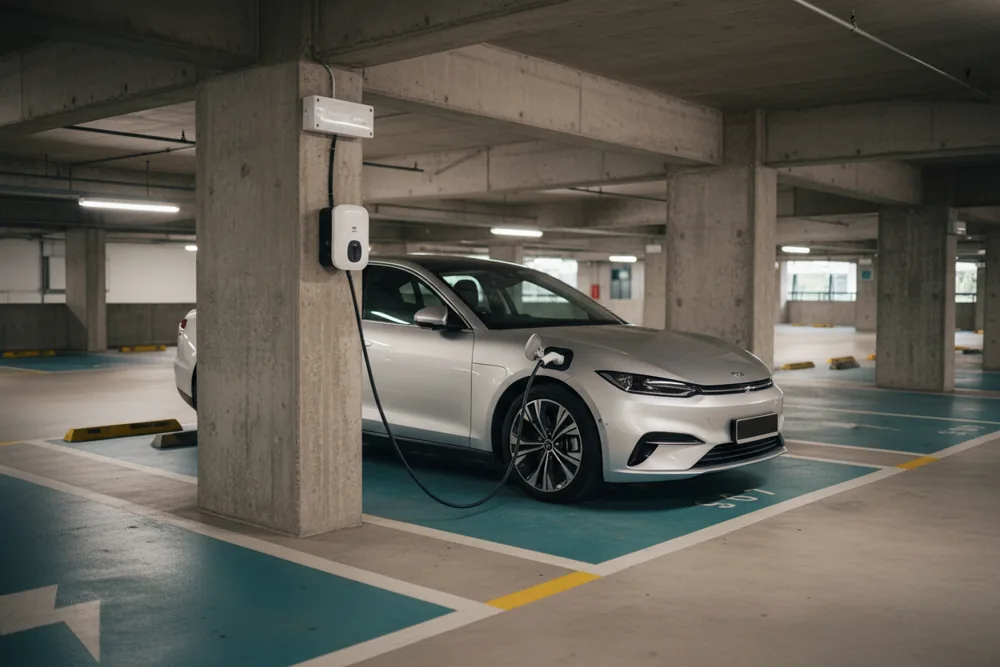
The short version
The honest constraint: what limits charging in a development is not willingness or parking lots, it is the incoming electrical supply and how it is distributed. The good news is that load management softens that constraint enormously, because cars sit parked for hours and do not need continuous full power. The rest of this page separates the four routes a resident actually has, and what each one requires.
The question everyone is actually asking
The most-commented result on this entire search is a Singapore EV owners’ thread with eighty-plus comments, and it poses the problem precisely: a condominium of 500 units, 400 of them with electric vehicles, and infrastructure that can only support a fraction of that.
Charging operators answer it commercially. Property portals answer it with rollout statistics. Residents answer each other with anecdote. Not one electrician answers it electrically, which is odd, because it is an electrical question.
What a development’s supply actually limits
The constraint is the incoming supply and the distribution behind it, not the number of parking lots and not the goodwill of the management corporation.
A development was designed around a predictable set of loads: lighting, lifts, pumps, common services and whatever the units themselves draw. It was not designed around several hundred vehicles each taking a few kilowatts for hours at a time. Adding chargers is therefore not a matter of finding wall space; it is a question of what the substation, the distribution and the risers can carry.
Load management is the real answer
And it is the part of this conversation that residents almost never hear. Load management means chargers that coordinate with each other and with the building, so the group never draws more than the supply can give.
Why it changes the maths
The naive calculation multiplies every charger by its maximum output and concludes the building would explode. The real pattern is different: a car parks overnight for eight or ten hours and typically needs far less energy than that window allows. Spread across a managed group, a development can often serve many more vehicles than the naive sum suggests, because they are not all charging at full rate at the same moment, and the system enforces that.
It is the same principle behind home EV charger installation in a single flat, where a load-managing charger can make an otherwise marginal supply workable, just applied at building scale.
The other appliance that forces the same conversation in a flat is the heater, and the trade-off is set out in the storage versus instant heater comparison.